
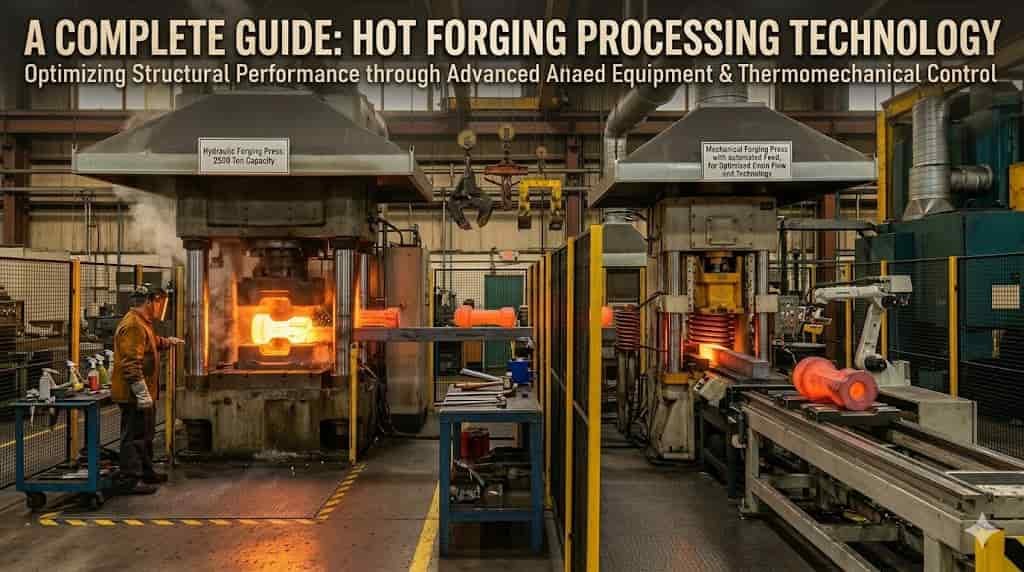
Explore hot forging processing technology: working principles, microstructural grain flow, equipment selection, and safety standards vs. cold forging.
Introduction: The Core Challenge in Metal Forming
In heavy manufacturing, producing components that simultaneously meet high structural integrity, dimensional accuracy, and fatigue resistance is a persistent engineering challenge. Conventional casting often introduces porosity and weak grain structures that fail under cyclic loading. This is where hot forging processing technology becomes the preferred solution for high-stress industrial components.
Hot forging processing technology is not simply heating and hammering. It is a precisely controlled thermomechanical process that refines grain structure, eliminates internal voids, and produces near-net-shape components with mechanical properties that casting cannot replicate.
What Is Hot Forging Processing Technology?
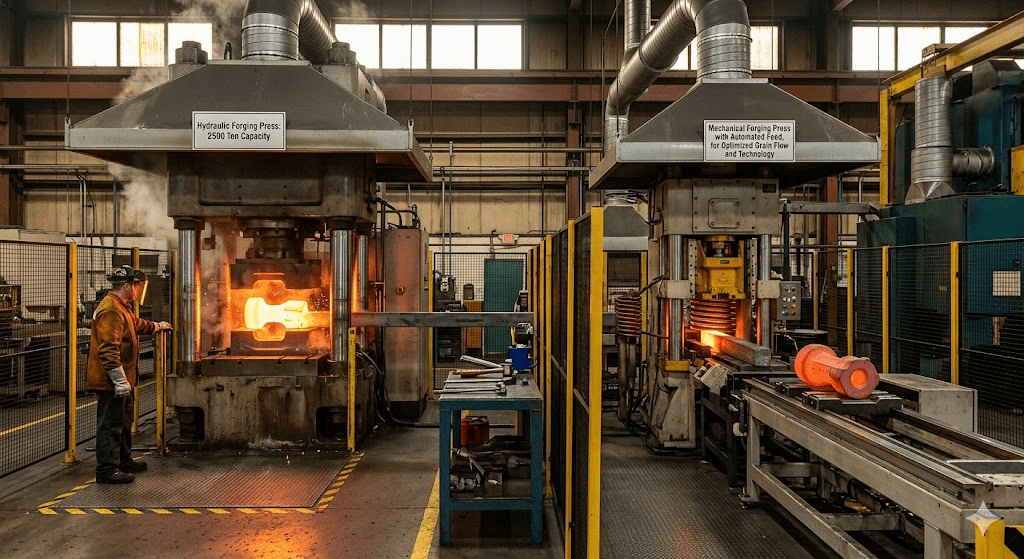
Hot forging processing technology is a bulk metal deformation process conducted above the material’s recrystallization temperature. For steel alloys, this typically ranges between 950°C and 1,250°C (1,742°F to 2,282°F). At these extreme temperatures, the metal’s flow stress drops significantly, enabling plastic deformation at lower press tonnage than in cold or warm forging.
The defining characteristic of hot forging processing technology is dynamic recrystallization. As the material deforms, new equiaxed grains continuously nucleate and grow, replacing deformed grains. This produces a refined, homogeneous microstructure with superior mechanical performance, making the component highly resistant to fatigue.
This guide covers the complete technical scope, from fundamental working mechanisms and equipment selection to industrial applications, safety protocols (OSHA/ISO), and a direct comparison with cold forging methods.
What Is Hot Forging Processing Technology?
Hot forging processing technology is a bulk metal deformation process conducted above the material’s recrystallization temperature. For steel alloys, this typically ranges between 950°C and 1,250°C (1,742°F to 2,282°F). At these extreme temperatures, the metal’s flow stress drops significantly, enabling plastic deformation at lower press tonnage than in cold or warm forging.
The defining characteristic of hot forging processing technology is dynamic recrystallization. As the material deforms, new equiaxed grains continuously nucleate and grow, replacing deformed grains. This produces a refined, homogeneous microstructure with superior mechanical performance, making the component highly resistant to fatigue.
1.Billet Preparation & Heating:Phase 1.
Raw billets or blooms cut from bar stock are loaded into induction furnaces or gas-fired rotary hearth furnaces. Precise temperature control is critical. Underheating increases flow stress and poses a risk of die damage, while overheating causes excessive scale formation and grain coarsening (burning). Typical soaking times depend on cross-sectional thickness, which is approximately 1 minute per millimeter of diameter for steel billets.
2.Die Setup & Lubrication:Phase 2.
Closed-die or open-die tooling is preheated to 150°C to 300°C to minimize thermal shock and reduce die chilling of the workpiece surface. Graphite-based or synthetic lubricants are applied to reduce the friction coefficient (typically $\mu=0.1$ to $0.3$) and facilitate smooth metal flow into die cavities during the cycle.
3.Forging Operation:Phase 3.
The heated billet is positioned in the die and struck by a hammer, mechanical press, or hydraulic press. Metal flows under compressive load, filling the die cavity. Flash (excess material) forms at the parting line, which also generates back-pressure that ensures complete die fill.
Key parameters: Strain rate ($1 \text{ to } 100 \text{ s}^{-1}$ for hammers), Forging pressure ($550 \text{ to } 950 \text{ MPa}$ for medium carbon steels), and Deformation Energy ($\text{Force} \times \text{Displacement}$).
Key process parameters include:
- Strain rate: 1 to 100 s−1 (hammer) versus 0.1 to 10 s−1 (hydraulic press)
- Forging pressure: 550 to 950 MPa for medium carbon steels
- Deformation Energy: Calculated asForce×Displacement
4.Trimming, Cooling & Heat Treatment:Phase 4.
Flash is removed in trimming dies immediately after forging while the part is still hot. Controlled cooling (air, forced air, or quench) follows, often succeeded by normalizing or quench-and-temper cycles to achieve target mechanical properties.
Industrial Applications & Use Cases
1. Automotive & Transportation
Hot forging processing technology is the backbone of powertrain and suspension manufacturing. Components such as crankshafts, connecting rods, wheel hubs, differential gears, and steering knuckles are exclusively hot forged. The fatigue life improvement over cast equivalents can exceed 30% to 50% under identical loading conditions. (For more details on automated production lines, see our internal guide on Automotive Manufacturing Systems).
2. Aerospace & Defense
Titanium alloys (Ti-6Al-4V) and nickel superalloys (Inconel 718) used in turbine discs, compressor blades, and structural airframe brackets are processed via isothermal hot forging. This is a specialized variant where dies are maintained at workpiece temperature to prevent premature cooling and ensure uniform deformation throughout thick cross-sections.
3. Oil & Gas Infrastructure
Valve bodies, flanges, pipe fittings, and wellhead components are hot forged from F316 stainless steel or duplex stainless to meet international standards. The forged grain flow pattern aligned with part geometry provides superior resistance to stress corrosion cracking (SCC) in sour service environments.
4. Heavy Equipment & Mining
Excavator bucket teeth, loader arms, drill collars, and mining picks demand extreme surface hardness combined with a tough core. Advanced manufacturing setups achieve this dual-property requirement effectively.
Technical Comparison: Hot vs. Warm vs. Cold Forging
| Parameter | Hot Forging | Warm Forging | Cold Forging |
| Operating Temperature | Above recrystallization ($950^{\circ}\text{C}$–$1250^{\circ}\text{C}$ for steel) | Below recrystallization ($550^{\circ}\text{C}$–$750^{\circ}\text{C}$ for steel) | Room temperature (Ambient / $<150^{\circ}\text{C}$) |
| Press Tonnage Required | Very Low (Metal flows easily) | Moderate | Very High (Due to strain hardening) |
| Dimensional Accuracy | Low to Moderate (Thermal shrinkage) | High | Excellent (Net-shape) |
| Surface Finish | Rough (Oxidation scale forms) | Smooth / Semi-bright | Pristine / Bright |
| Microstructural Impact | Dynamic Recrystallization | Partial Recrystallization | Work Hardening (Strain Hardening) |
| Material Waste | High (Due to flash generation) | Low | Very Low / Zero Waste |
Mechanical Property Trade-Offs
- Strength vs. Ductility: Cold forging increases the material’s yield strength significantly via strain hardening without needing post-forge heat treatment. On the other hand, hot forging processing technology maximizes ductility, allowing complex shapes to fill out perfectly without cracking.
- Grain Integrity: Modern production setups create uninterrupted, contour-following grain flow lines. This eliminates internal planes of weakness, providing unmatched resistance to heavy cyclic stresses and structural impacts. For an in-depth breakdown of raw material selection before forging, refer to our Metal Metallurgy Overview.
Equipment Types & Selection Matrix
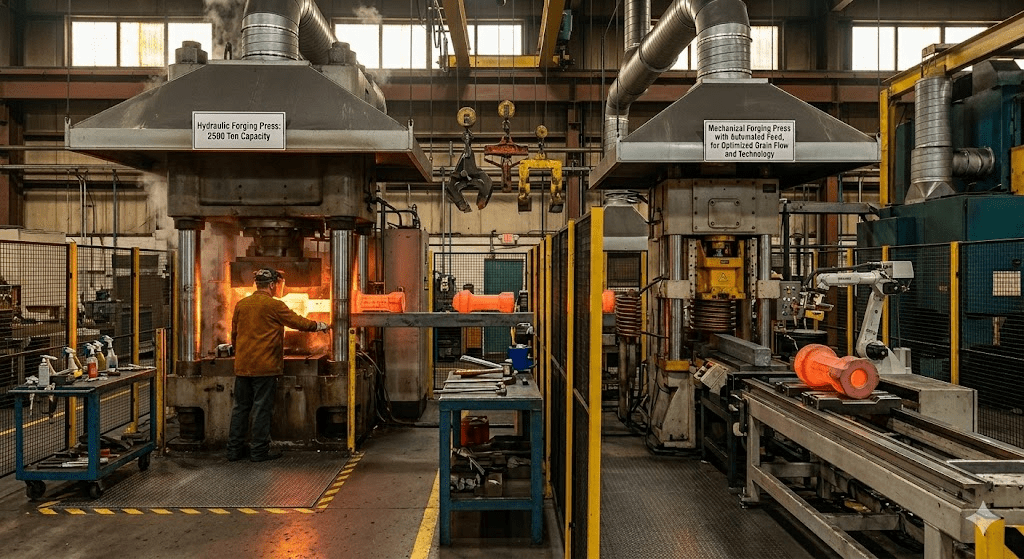
The choice of machinery dictates the production speed, thermal contact, and microstructural quality of your finished part:
- Forging Hammers (Impact Energy-Driven): Converts kinetic energy from a falling heavy ram into an instantaneous deformation force. It has a very high strain rate ($1 \text{ to } 100 \text{ s}^{-1}$). Best for small to medium parts requiring fast, aggressive deformation across multiple die cavities.
- Mechanical Presses (Stroke-Restricted): Uses a motor-driven eccentric shaft to convert rotary motion into a fixed-length vertical stroke. It operates at a moderate strain rate ($0.1 \text{ to } 10 \text{ s}^{-1}$). Best for high-volume mass production where extreme part-to-part consistency is mandatory.
- Hydraulic Presses (Force-Restricted): High-pressure hydraulic fluid delivers a continuous, maximum pressing force throughout the entire length of the stroke. It operates at a low strain rate ($0.01 \text{ to } 1 \text{ s}^{-1}$). Best for large, massive structural components and hard-to-deform aerospace alloys that require a slow, deep “squeeze.”
Safety Standards & Regulatory Compliance
Because facilities deal with extreme thermal levels and crushing mechanical kinetic forces, compliance with international safety protocols is strictly mandated.
OSHA Standards (United States)
- 29 CFR 1910.218 (Forging Machines): Dictates strict safety parameters for die-setting protocols, mandatory foot-pedal guards to prevent accidental stamps, and lock-out/tag-out (LOTO) mechanisms during tool changes. For detailed guidelines, check the official OSHA Forging Machine Standards.
- 29 CFR 1910.95 (Occupational Noise Exposure): Because impact hammers regularly exceed 100 dB, engineering controls like acoustic enclosures and dual hearing protection are heavily monitored.
ISO & European Standards
- EN 692 & EN 693: Specific standards governing mechanical and hydraulic systems to ensure hydraulic overrun protection and anti-repeat circuits prevent accidental double-strokes.
- ISO 13849-1: Evaluates safety-related parts of control systems (SRP/CS), ensuring light curtains, automated interlocks, and emergency stops meet mandatory Performance Levels (PL d or e). Learn more about control system integration via the International Organization for Standardization (ISO).
Frequently Asked Questions (FAQs)
1. What is the difference between hot forging and hot rolling?
While both are hot working thermomechanical processes, they serve different manufacturing goals. Hot forging processing technology uses localized, compressive forces (via dies or hammers) to shape a specific component into a complex geometry with optimized grain flow. Hot rolling, on the other hand, passes bulk metal through a series of continuous rollers to reduce thickness and create uniform cross-sectional profiles like steel sheets or structural I-beams.
2. Why is the preheating mandatory in hot forging processing?
Die preheating (typically between 150°C and 300°C) is critical to prevent thermal shock and die chilling. If a red-hot billet at 1200°C touches a cold tool-steel die, the rapid temperature drop can fracture the die immediately. Furthermore, a cold die quickly draws heat away from the workpiece surface, raising its local flow stress and preventing the metal from filling tight die cavities correctly.
3. How does scale formation affect hot forged parts, and how is it controlled?
Scale is a layer of iron oxide ($\text{Fe}_2\text{O}_3$ or $\text{Fe}_3\text{O}_4$) that forms instantly when hot steel reacts with oxygen in the air. If not managed, this scale gets pressed into the component’s surface, causing pitting and dimensional errors. Manufacturers control scale by using induction heating (which reduces exposure time), applying protective synthetic coatings, and using high-pressure water descaling systems to blast the scale off the billet immediately before it enters the die.
4. Can hot forged parts be machined directly after cooling?
Rarely. Due to non-uniform cooling rates and high thermal stresses, hot forged components usually require a post-forge thermal cycle like normalizing or annealing. These treatments relieve internal residual stresses, homogenize the microstructures, and lower hardness to an acceptable level so the parts can be safely and efficiently machined into their final tolerances.
5. Why is titanium hot forged under “isothermal” conditions instead of conventional hot forging?
Titanium alloys (like Ti-6Al-4V) have a narrow processing temperature window and high thermal sensitivity. In conventional hot forging processing technology, the cooler dies cause the titanium surface to drop below its critical temperature, leading to cracking and incomplete die filling. Isothermal forging heats the dies to the exact same temperature as the titanium workpiece, eliminating thermal gradients and ensuring uniform deformation.
Latest Technology News & Innovations 2026
Conclusion: Maximizing Structural Performance
Hot forging processing technology remains an irreplaceable pillar of modern heavy manufacturing. By heating metals past their recrystallization thresholds, engineers can bypass the massive flow-stress barriers that limit cold forming, unlocking the ability to form dense, high-strength geometries with minimal press force. The hallmark of this technology—dynamic recrystallization—completely restructures the material from within, aligning grain boundaries along the component’s exact stress contours while eliminating internal cast defects.
As industries demand lighter, safer, and higher-fatigue-resistant parts, the deployment of automated induction heating, precise synthetic lubricants, and computerized hydraulic presses will continue to optimize hot forging processing technology. These advanced manufacturing setups perfectly align with the core shifts highlighted in the Latest Technology News & Innovations 2026. When component failure is not an option—whether in a commercial aircraft engine, an automotive steering system, or a high-pressure oil wellhead—this technology is the definitive choice for maximum structural integrity.