
Discover what the Cyber Intelligence Directorate DOE does, where it sits inside the Department of Energy, how it protects the U.S. energy grid, and how it differs from CESER and CISA.
If you’ve searched for “Cyber Intelligence Directorate DOE,” you’ve likely come across job postings, congressional reports, or brief mentions on energy.gov without a clear, plain-English explanation of what this office actually is, what it does, and why it matters. This article fixes that.
The Cyber Intelligence Directorate is a specialized component within the U.S. Department of Energy’s Office of Intelligence and Counterintelligence (DOE-IN), tasked with producing all-source cyber intelligence to protect the DOE enterprise, the National Nuclear Security Administration (NNSA), the national laboratories, and the broader U.S. energy sector from foreign cyber threats. It sits at the intersection of national security intelligence and critical infrastructure protection — a role that has grown significantly more important as adversarial nations increasingly target power grids, pipelines, and nuclear facilities through cyberspace.
This guide breaks down its mission, structure, day-to-day functions, how it fits into the wider U.S. Intelligence Community, and how it differs from other DOE cybersecurity offices people often confuse it with.
What Is the Cyber Intelligence Directorate (DOE)?
The Cyber Intelligence Directorate is one of several directorates operating under DOE’s Office of Intelligence and Counterintelligence, commonly abbreviated as DOE-IN. According to federal job postings and organizational records, the Directorate “provides cyber intelligence analysis and Information Technology services to the DOE Enterprise, U.S. Intelligence Community and U.S. Energy Sector.”
In simpler terms, its job is twofold:
- Produce intelligence — Analyze foreign cyber threats targeting DOE, NNSA, national laboratory networks, and the U.S. energy grid, and turn raw data into actionable reports for decision-makers.
- Provide IT infrastructure — Support DOE-IN’s own technical operations, ensuring the office’s systems and analytic tools function securely and reliably.
Unlike a traditional corporate IT security team, this Directorate operates as part of the U.S. Intelligence Community (IC). That means its products follow formal intelligence tradecraft standards, and its analysts brief senior officials up to the Secretary of Energy, National Security Council staff, and members of Congress.
Quick Facts Table
| Attribute | Detail |
|---|---|
| Parent Office | Office of Intelligence and Counterintelligence (DOE-IN) |
| Parent Department | U.S. Department of Energy |
| Community Membership | U.S. Intelligence Community (IC) |
| Core Mission | All-source cyber intelligence on threats to DOE, NNSA, national labs, and the energy sector |
| Related Sub-units | Cyber Analysis Division, Cyber Special Programs Division |
| Headquarters | James V. Forrestal Building, Washington, D.C. |
| Typical Roles | Intelligence Research Specialist, Cyber Intelligence Analyst, IT/Network Operations Specialist |
Where the Cyber Intelligence Directorate Fits Inside DOE
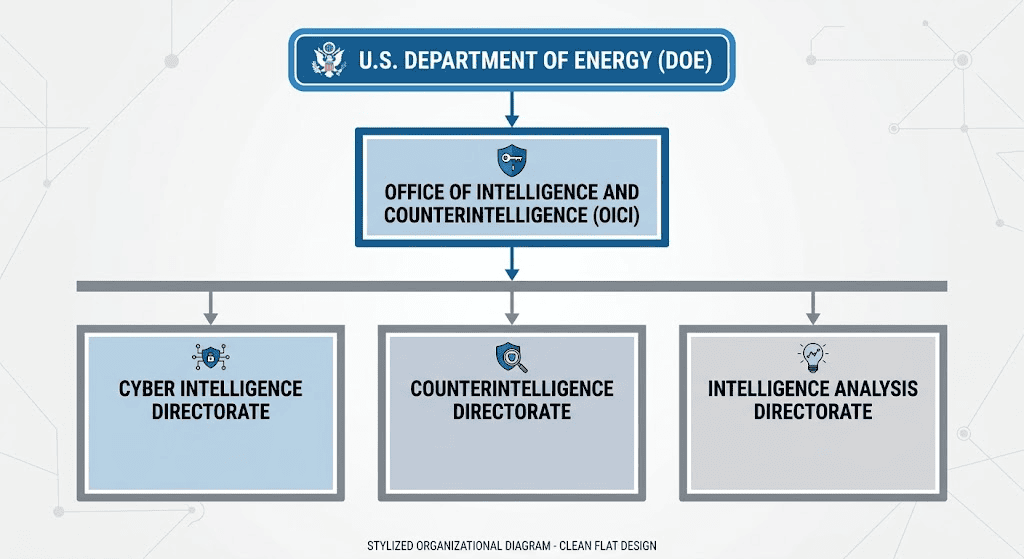
To understand the Directorate, it helps to see the larger organizational picture. DOE’s Office of Intelligence and Counterintelligence is organized into multiple directorates, each with a distinct mandate:
- Intelligence Analysis Directorate — Focuses on foreign nuclear weapons, fuel-cycle programs, and broader energy-security intelligence.
- Counterintelligence Directorate — Protects DOE and NNSA from foreign intelligence targeting, espionage, and insider threats.
- Cyber Intelligence Directorate — Focuses specifically on cyber threats to DOE networks, national laboratories, and U.S. energy infrastructure.
These directorates don’t operate in silos. Cyber threat data often intersects with counterintelligence investigations — for example, a suspected foreign intrusion into a national laboratory network may trigger both a cyber intelligence assessment and a parallel counterintelligence inquiry into how access was obtained.
DOE-IN, as a whole, traces its roots back to the Manhattan Project’s original intelligence effort and became a unified office in 2006 after the merger of previously separate intelligence and counterintelligence functions. As the Department of Energy explains on its official intelligence pages, this counterintelligence and cyber threat intelligence support exists to protect people, facilities, and intellectual property across the DOE complex, while also helping defend the largely privately-owned energy sector.
Core Functions of the Cyber Intelligence Directorate
Based on official DOE hiring documents and organizational descriptions, the Directorate’s responsibilities generally fall into four categories.
1. All-Source Cyber Intelligence Production
Analysts within the Directorate synthesize multiple intelligence disciplines — signals intelligence, human intelligence, open-source data, and technical indicators — into finished reports that “characterize, assess, and contextualize ongoing cyber threats” to DOE, NNSA, national laboratory, and U.S. energy sector networks. These products are required to comply with Intelligence Community Directive 203, the federal standard governing analytic tradecraft across all IC agencies.
2. Threat Briefings for Senior Leadership
The Directorate’s leadership regularly briefs high-level stakeholders, including:
- The Secretary and Deputy Secretary of Energy
- National Security Council staff
- Congressional members and staff
- Executives at other federal departments and agencies
This places the office in a genuinely influential position — its analysis can shape national policy decisions around grid security, nuclear facility protection, and cyber deterrence strategy.
3. IT Infrastructure and Network Operations Support
A lesser-known part of the Directorate’s mandate is purely operational: it builds and maintains the IT infrastructure that DOE-IN itself relies on. This includes network operations, system security, and ensuring the analytic workforce has secure tools to handle classified and sensitive information.
4. Coordination With the Broader Cybersecurity Ecosystem
The Directorate doesn’t work in isolation. It coordinates with:
- DOE’s Office of Cybersecurity, Energy Security, and Emergency Response (CESER) — the office responsible for the operational and policy side of energy-sector cybersecurity
- DOE and NNSA Chief Information Officers (CIOs) — for protecting internal DOE and NNSA networks, including the Power Marketing Administrations
- The Office of Electricity — on grid-specific technical matters
- The wider Intelligence Community’s cyber components, such as those at the NSA, CIA, and ODNI
Cyber Intelligence Directorate vs. CESER vs. CISA: What’s the Difference?
This is where most confusion happens. All three organizations touch “energy sector cybersecurity,” but they play very different roles. The table below breaks it down.
| Organization | Type | Primary Role | Audience |
|---|---|---|---|
| Cyber Intelligence Directorate (DOE-IN) | Intelligence Community component | Produces classified all-source cyber threat intelligence and analysis | DOE leadership, NNSA, IC, national security policymakers |
| CESER (Office of Cybersecurity, Energy Security, and Emergency Response) | DOE operational/policy office | Sets energy-sector cybersecurity policy, funds resilience programs, coordinates incident response | Utilities, grid operators, energy companies, DOE leadership |
| CISA (Cybersecurity and Infrastructure Security Agency) | Department of Homeland Security agency | Cross-sector critical infrastructure protection, vulnerability alerts, incident response coordination | All 16 critical infrastructure sectors nationwide |
In short:
- The Cyber Intelligence Directorate tells decision-makers what threats exist and who is behind them, using classified intelligence sources.
- CESER decides what policies, funding, and resilience programs should exist to defend against those threats.
- CISA is the cross-government agency that issues public alerts and coordinates incident response across all critical infrastructure sectors, not just energy.
Understanding this distinction matters if you’re researching DOE cybersecurity for academic, journalistic, career, or compliance purposes — each office has a different mission, different audience, and different level of public transparency.
Why the Energy Sector Is a High-Priority Cyber Intelligence Target
The energy grid is one of the most attractive targets for state-sponsored cyber actors because disrupting it creates cascading effects across nearly every other sector — transportation, healthcare, water systems, communications, and finance. This is precisely why DOE maintains a dedicated intelligence directorate for cyber threats rather than folding this function entirely into general IT security teams.
Common categories of threats the Directorate and its partners track include:
- Nation-state reconnaissance of grid control systems and industrial control systems (ICS/SCADA)
- Supply chain compromises targeting hardware or software used in energy infrastructure
- Espionage campaigns aimed at stealing nuclear research or proprietary energy technology
- Ransomware and destructive malware capable of disrupting operational technology (OT) environments
- Insider threats with access to sensitive DOE or national laboratory systems
As the Office of the Director of National Intelligence notes, DOE’s intelligence office provides the U.S. government with critical insight into foreign intelligence, terrorist, and cyber threats — expertise made possible in part by DOE’s network of 17 national laboratories, which develop advanced scientific and technological capabilities used across the broader Intelligence Community.

Structure: Divisions Within the Cyber Intelligence Directorate
Federal job postings reveal at least two sub-divisions operating under the Directorate:
Cyber Analysis Division
Handles the analytic side of the mission — producing finished intelligence products, tracking adversary tactics, techniques, and procedures (TTPs), and assessing the severity of threats to DOE and energy-sector networks.
Cyber Special Programs Division
Includes specialized functions such as the “Pursuit Branch,” referenced in federal job listings, which appears to focus on more targeted or sensitive cyber threat pursuit activities beyond standard analytic reporting.
Leadership of the Directorate is typically held by a Deputy Director for Cyber, a senior executive role responsible for overseeing both the intelligence-analysis mission and the CIO-adjacent technical functions for DOE-IN.
How the Directorate Supports the Broader Intelligence Community
DOE-IN, and by extension the Cyber Intelligence Directorate, is a full member of the 18-agency U.S. Intelligence Community. Its niche contribution comes from DOE’s unmatched access to scientific and technical expertise, particularly around nuclear material, energy systems, and advanced computing.
The Office of the Director of National Intelligence (ODNI) has publicly noted that DOE’s intelligence office provides the government with critical insights to respond to foreign intelligence, terrorist, and cyber threats while tackling the era’s most pressing scientific and technological challenges — a role made possible by DOE’s network of 17 national laboratories, which develop cutting-edge scientific and technical capabilities used across the IC.
This scientific backbone is what differentiates DOE’s cyber intelligence function from that of a typical federal CISO office: analysts frequently draw on deep technical expertise in supercomputing, nuclear engineering, and advanced materials science when assessing cyber threats to specialized systems.
Careers in the Cyber Intelligence Directorate: What the Roles Look Like
If your search for “cyber intelligence directorate DOE” is career-motivated, here’s what to expect based on publicly posted federal vacancy announcements.
Common Position Types
- Intelligence Research Specialist (including supervisory GS-15 roles) — leads all-source cyber intelligence teams
- Cyber Security Analyst — characterizes, counters, and predicts threats to DOE systems and networks
- Information Technology/Network Operations Specialist — provides IT solutions supporting DOE-IN’s counterintelligence and cyber missions
- Program Analyst — supports planning, budgeting, and program management functions within the Directorate
Typical Requirements
- U.S. citizenship and eligibility for a Q-level security clearance (DOE’s equivalent of Top Secret)
- Background in intelligence analysis, cybersecurity, computer science, or a related technical field
- Willingness to work primarily in the Washington, D.C. metro area, though DOE-IN also operates from field offices at DOE facilities nationwide
- For senior roles, demonstrated experience briefing senior government executives and producing IC-compliant analytic products
Step-by-Step: How to Approach a DOE-IN Cyber Intelligence Career Path
- Build a technical or analytic foundation. A degree in cybersecurity, computer science, intelligence studies, or a related field is typically expected, along with demonstrable analytic writing skills.
- Gain clearance-eligible experience. Prior federal, military, or IC-adjacent work — even in unrelated agencies — helps because it often comes with an existing security clearance or clearance-eligible background investigation.
- Monitor USAJOBS listings directly. Positions within DOE-IN’s Cyber Directorate are posted on USAJOBS under the Department of Energy, often listed as “Cyber Intelligence Directorate” or simply “Cyber Directorate.”
- Understand IC tradecraft standards. Familiarity with Intelligence Community Directive 203 and structured analytic techniques is a genuine advantage in interviews and on the job.
- Prepare for a lengthy clearance process. Q-clearance investigations can take months; starting early and maintaining a clean, consistent background record matters.

Common Questions About the Cyber Intelligence Directorate DOE
Is the Cyber Intelligence Directorate a public-facing agency?
No. It is a component of the Intelligence Community and primarily produces classified or sensitive intelligence products for internal government use, not public reports. Public-facing energy cybersecurity guidance more commonly comes from CESER or CISA.
Does it respond to cyberattacks directly?
Not typically in an operational, hands-on-keyboard sense. Its role is intelligence production and analysis — understanding who is behind a threat and what their intentions and capabilities are — rather than performing incident response, which falls more to CIO/CISO teams, CESER, and CISA.
How does it relate to the National Nuclear Security Administration (NNSA)?
DOE-IN, including the Cyber Intelligence Directorate, provides cyber threat intelligence covering NNSA networks and facilities, since NNSA operates under the DOE umbrella and manages the U.S. nuclear weapons stockpile alongside civilian energy security missions.
Can private energy companies access its intelligence products?
Generally not directly, since products are classified and intended for government decision-makers. However, threat information can be downgraded, sanitized, and shared with the private energy sector through channels like CESER, sector-specific information sharing organizations, and CISA advisories.
Final Thoughts
The Cyber Intelligence Directorate DOE occupies a specific and often misunderstood niche: it’s not a public cybersecurity agency, not a policy office, and not an incident-response team. It’s the intelligence engine that helps the Department of Energy, the National Nuclear Security Administration, and the broader U.S. energy sector understand who is targeting them in cyberspace and why — all while operating under formal Intelligence Community tradecraft standards.
For anyone researching DOE’s cybersecurity structure — whether for a career path, academic research, journalism, or general national security interest — understanding where this Directorate sits relative to DOE-IN, CESER, and CISA is the key to making sense of how the U.S. government protects its energy infrastructure from cyber threats.