
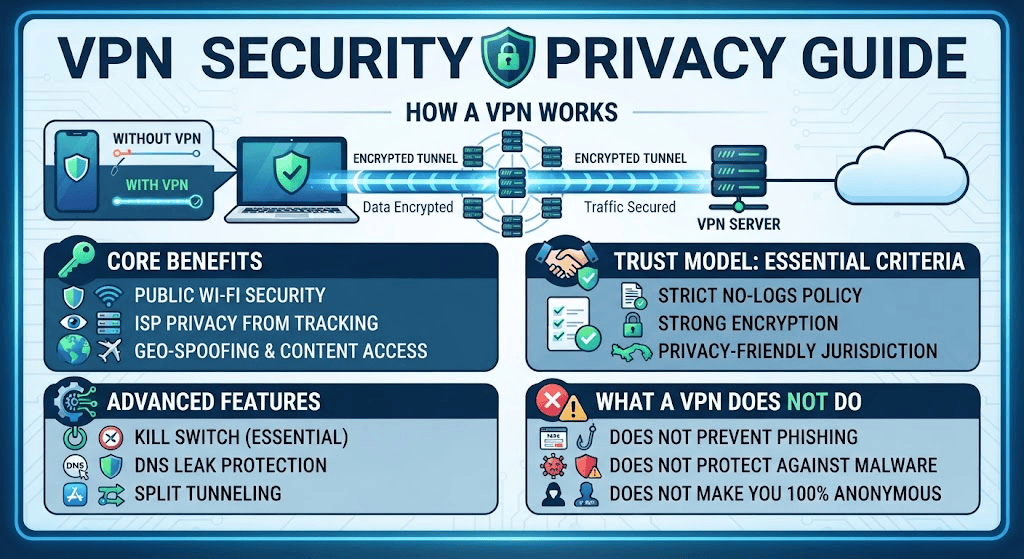
Learn how VPNs protect your privacy with this complete VPN security & privacy guide covering encryption, protocols, no-logs policies, and 10 practical safety tips.
VPN Security & Privacy Guide: 10 Ways to Protect Yourself Online in 2026
Every time you connect to public Wi-Fi, log into your bank account, or simply browse the web, you leave behind a trail of data. Internet service providers, advertisers, and sometimes hackers can see far more about your online activity than most people realize. That’s why a solid VPN security & privacy guide has become essential reading for anyone who wants real control over their digital footprint.
This VPN security & privacy guide breaks down exactly how VPNs work, what to look for in a trustworthy provider, and the practical steps needed to stay safe online. A Virtual Private Network (VPN) is one of the most accessible privacy tools available, but installing one isn’t enough — choosing the wrong provider or misconfiguring settings can leave you with a false sense of security.
Whether you’re new to VPNs or want to tighten up your current setup, consider this your complete VPN security & privacy guide to encryption basics, provider selection, and the common mistakes that quietly undermine protection.
What Is a VPN? (VPN Security & Privacy Guide Basics)
Understanding the fundamentals is the first step in any useful VPN security & privacy guide. A VPN creates an encrypted tunnel between your device and the internet, masking your IP address and scrambling your traffic so outsiders can’t easily read it.
According to Cloudflare’s technical documentation, a VPN is fundamentally an internet security service that lets users access the internet as though connected to a private network.A virtual private network (VPN) is an Internet security service that allows users to access the Internet as though they were connected to a private network, and this encrypts Internet communications and provides a strong degree of anonymity. This is the foundation every VPN security & privacy guide starts with, because without encryption, none of the privacy benefits people expect from a VPN actually apply.
Why People Use a VPN for Security and Privacy
- Protecting data on public Wi-Fi — cafés, airports, and hotels are common targets for snooping.
- Preventing ISP tracking — stopping your provider from logging your browsing habits.
- Bypassing geo-restrictions — accessing content unavailable in your region.
- Securing remote work connections — reaching company networks safely.
- Reducing targeted ads — masking your IP makes tracking harder.
How VPN Encryption Works: A Core Part of Any VPN Security & Privacy Guide
Encryption is the backbone of any VPN security & privacy guide. When you connect to a VPN, your device and the VPN server establish a secure tunnel using a VPN protocol. Data is encrypted before it leaves your device and decrypted only at its destination — anyone intercepting it in between sees unreadable data.
Common VPN Protocols Compared
| Protocol | Speed | Security Level | Best Use Case |
|---|---|---|---|
| OpenVPN | Moderate | Very High | General-purpose daily use |
| WireGuard | Fast | High | Streaming, gaming, mobile |
| IKEv2/IPsec | Fast | High | Switching Wi-Fi to mobile data |
| L2TP/IPsec | Slower | Moderate | Legacy systems only |
| PPTP | Fastest | Low (outdated) | Avoid for sensitive data |
Choosing the right protocol is one of the most technical — but important — decisions in this VPN security & privacy guide, since it directly determines how well your traffic is protected.
10 Ways to Strengthen Your VPN Security and Privacy
This section is the core of any practical VPN security & privacy guide — the actionable steps that actually reduce your exposure.
1. Choose a No-Logs VPN Provider
A “no-logs” policy means the provider doesn’t record your browsing history or IP addresses. Look for providers whose no-logs claims have been independently audited.
2. Verify Jurisdiction and Data Laws
Some countries participate in intelligence-sharing alliances that can affect how user data is handled if legally requested.
3. Enable a Kill Switch
A kill switch cuts your internet connection if the VPN drops, preventing your real IP from leaking unprotected.
4. Use DNS Leak Protection
Even with a VPN active, DNS requests can sometimes bypass the encrypted tunnel. Reputable providers include built-in leak protection.
5. Avoid Free VPN Services for Sensitive Activity
Free VPNs often recoup costs by logging or selling user data. For anything sensitive, a paid provider is safer.
6. Keep Your VPN Software Updated
Outdated apps can carry unpatched vulnerabilities — enable automatic updates where possible.
7. Combine VPN Use With HTTPS
A VPN encrypts traffic to its server, but the connection onward still depends on the destination site’s own security. Always check for HTTPS.
8. Disable IPv6 If Your VPN Doesn’t Support It
Some VPNs only route IPv4 traffic, leaving IPv6 exposed unless you disable it manually.
9. Use Split Tunneling Carefully
Split tunneling lets you choose which apps route through the VPN — be intentional so sensitive apps aren’t accidentally excluded.
10. Review App Permissions and Data Collection Policies
Check what permissions a VPN app requests before installing it, and read the privacy policy carefully.
Following these ten steps is the practical heart of this VPN security & privacy guide, turning a basic VPN subscription into a genuinely secure setup.
VPN vs. Other Privacy Tools: What’s the Difference?
People often confuse VPNs with other privacy technologies:
| Tool | What It Does | What It Doesn’t Do |
|---|---|---|
| VPN | Encrypts traffic, masks IP address | Doesn’t block malware or phishing |
| Tor Browser | Routes traffic through multiple nodes | Can be slower; not ideal for streaming |
| Proxy Server | Masks IP for specific apps | Usually doesn’t encrypt traffic |
| Antivirus Software | Detects and removes malware | Doesn’t hide your IP or encrypt traffic |
| Ad Blocker | Blocks trackers and ads | Doesn’t protect network-level traffic |
A well-rounded privacy setup — a key theme throughout this VPN security & privacy guide — combines a VPN with an ad blocker and updated antivirus rather than relying on one tool alone.
Common VPN Security Mistakes to Avoid
Even readers who follow a VPN security & privacy guide closely can undo their own protection with small errors:
- Leaving the VPN off “just for a quick search”
- Choosing a provider based only on price
- Ignoring server location choices
- Assuming a VPN makes you completely anonymous
- Not testing for leaks after setup
How to Choose the Right VPN: A Quick Checklist
- Independently audited no-logs policy
- Strong encryption (AES-256 is the current benchmark)
- Kill switch and DNS leak protection included
- Transparent jurisdiction and ownership
- Clear, readable privacy policy
- Reasonable pricing with a refund period
Cloudflare’s overview notes that unencrypted internet traffic exposes user information at every step of a website request.Information about the user is exposed in every step of the website request, and since the user’s IP address is exposed throughout the process, the ISP and any other intermediary can keep logs of the user’s browsing habits. Closing this exact gap is the whole point of following a proper VPN security & privacy guide.
Do You Actually Need a VPN?
If you frequently use public Wi-Fi, want to limit ISP tracking, travel to restricted regions, or handle sensitive remote work data, a VPN adds meaningful protection. For mostly casual home browsing, the urgency is lower — but as any thorough VPN security & privacy guide will tell you, a VPN still strengthens your overall protection against passive tracking.
Frequently Asked Questions
1. Does a VPN make me completely anonymous online?
No. As this VPN security & privacy guide explains, a VPN masks your IP and encrypts traffic, but logged-in accounts and browser fingerprinting can still identify you.
2. Can a VPN slow down my internet speed?
Yes, somewhat — though modern protocols like WireGuard minimize the impact.
3. Is it legal to use a VPN?
In most countries, yes, though a few restrict or ban VPN use.
4. Can my ISP still see that I’m using a VPN?
They can see you’re connected to a VPN server, but not the content of your encrypted traffic.
5. Are free VPNs safe to use?
Some are fine for light browsing, but many monetize through data logging — paid options are safer for sensitive use.
6. What’s the difference between a VPN and incognito mode?
Incognito only clears local browser history; it doesn’t hide your IP or encrypt traffic like a VPN does.
7. Do I need a VPN on my phone too?
Yes — mobile devices connect to public Wi-Fi just as often and are equally exposed.
8. How do I check if my VPN is actually working?
Run a DNS leak test and IP checker before and after connecting to confirm your real IP and DNS aren’t exposed. This one check completes the practical side of this VPN security & privacy guide.
Final Thoughts
A trustworthy VPN, used correctly, remains one of the most accessible tools for protecting your privacy online. This VPN security & privacy guide has covered the fundamentals — encryption, protocol choice, and provider vetting — so you can build a setup that actually holds up under scrutiny, not just one that looks secure on paper. Bookmark this VPN security & privacy guide and revisit the checklist whenever you evaluate a new provider.