

Explore security information analyst jobs in 2026 — responsibilities, must-have skills, certifications, salary ranges, and a step-by-step roadmap to land your first role.
If you’ve been scrolling job boards and keep landing on postings for security information analyst jobs, you’ve picked one of the most in-demand corners of the tech industry right now. Every organization that touches the internet — banks, hospitals, retailers, government agencies — needs someone watching the digital front door. That someone is usually a security information analyst.
This guide breaks down exactly what the job involves, what employers actually expect on your resume, how much you can realistically earn, and the fastest legitimate path into the role — whether you’re switching careers, graduating soon, or already in IT and looking to specialize.
What Does a Security Information Analyst Actually Do?
A security information analyst (often used interchangeably with “information security analyst” or “cybersecurity analyst”) is responsible for protecting an organization’s computer networks, systems, and data from unauthorized access, breaches, and cyberattacks.
In practice, the day-to-day work centers on four pillars:
- Monitoring — watching network traffic, logs, and security tools for unusual or malicious activity
- Detecting — identifying vulnerabilities, misconfigurations, or active threats before they cause damage
- Responding — containing incidents, investigating root causes, and coordinating remediation
- Reporting — documenting findings and communicating risk to technical teams and non-technical leadership
Unlike a general IT support role, this job is defensive and investigative by nature. You’re not fixing printers — you’re figuring out why a login attempt came from three countries in ten minutes, or why an endpoint suddenly started sending traffic to an unfamiliar IP address.
A Typical Day in the Role
Most analysts split their time between three modes of work:
- Proactive monitoring — reviewing dashboards in a SIEM (Security Information and Event Management) platform, checking for anomalies flagged overnight
- Investigation — digging into alerts that automated tools escalate, determining if they’re false positives or genuine threats
- Documentation and improvement — writing incident reports, updating detection rules, and recommending policy changes to reduce future risk
No two days look identical, which is part of why the role attracts people who like variety and problem-solving over repetitive tasks.
Types of Security Information Analyst Jobs
The title covers a wide spectrum of seniority and specialization. Understanding where each one sits helps you target the right postings instead of applying broadly and getting filtered out.
| Job Level | Typical Title | Core Focus | Experience Needed |
|---|---|---|---|
| Entry-level | SOC Analyst (Tier 1) | Alert triage, log monitoring | 0–2 years |
| Mid-level | Security Information Analyst / Cybersecurity Analyst | Threat investigation, incident response | 2–5 years |
| Senior | Senior Security Analyst / Threat Hunter | Proactive threat hunting, forensics | 5–8 years |
| Specialized | Cloud Security Analyst, GRC Analyst, Malware Analyst | Domain-specific defense (cloud, compliance, reverse engineering) | Varies, often 3+ years |
| Leadership | Security Operations Manager / SOC Lead | Team oversight, strategy, vendor management | 7+ years |
If you’re just starting out, most security information analyst jobs at the entry level fall under a Security Operations Center (SOC), where you’ll work in a team monitoring alerts around the clock, often in rotating shifts.
Core Skills Employers Actually Screen For
Job postings can look intimidating because they list a dozen tools and frameworks. In reality, hiring managers are usually checking for a mix of hard technical skills and a few underrated soft skills.
Technical Skills
- Networking fundamentals — TCP/IP, DNS, firewalls, VPNs, and how traffic actually moves
- SIEM tools — Splunk, Microsoft Sentinel, IBM QRadar, or similar platforms for log analysis
- Operating system knowledge — comfort in both Windows and Linux environments
- Scripting basics — Python or PowerShell for automating repetitive tasks
- Vulnerability scanning tools — Nessus, Qualys, or Rapid7
- Understanding of the MITRE ATT&CK framework — a widely used reference for how attackers actually operate
Soft Skills That Set Candidates Apart
- Written communication — you’ll write incident summaries that non-technical executives need to understand quickly
- Calm under pressure — active incidents require clear thinking, not panic
- Curiosity and pattern recognition — the best analysts notice when something is “off” even before an alert fires
- Collaboration — you’ll work closely with IT, legal, and compliance teams, especially during a breach
A common mistake among job seekers is over-indexing on certifications while under-preparing for the practical, hands-on questions asked in interviews (e.g., “walk me through how you’d investigate a phishing alert”). Employers value demonstrated reasoning over memorized definitions.
Certifications That Actually Move the Needle
Certifications won’t replace experience, but for candidates without a security-specific degree, they’re often the deciding factor between an interview and a rejection.
| Certification | Best For | Difficulty |
|---|---|---|
| CompTIA Security+ | Absolute beginners, IT-to-security switchers | Beginner |
| Certified SOC Analyst (CSA) | SOC-specific roles | Beginner–Intermediate |
| GIAC Security Essentials (GSEC) | Broader technical foundation | Intermediate |
| Certified Information Systems Security Professional (CISSP) | Mid-to-senior roles, management track | Advanced (requires experience) |
| Certified Ethical Hacker (CEH) | Roles touching offensive security or red teaming | Intermediate |
CompTIA Security+ is widely treated as the industry starting point — it’s built around practical, hands-on skills like identifying threats, using security tools, and designing secure network architectures, rather than pure theory. Reviewing the official exam objectives before you commit to a study plan will save you from studying the wrong things.
How Much Do Security Information Analyst Jobs Pay?
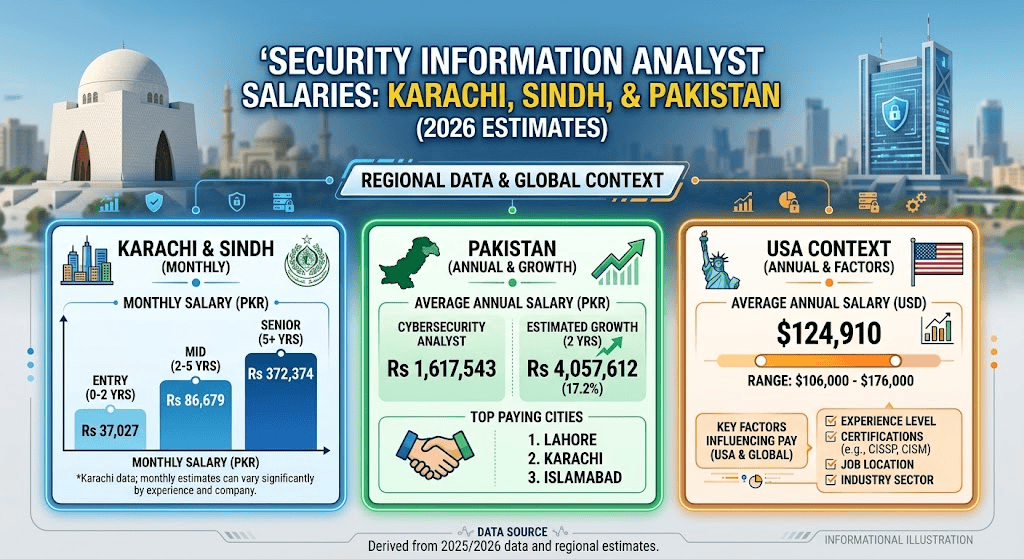
Compensation varies significantly by region, industry, and seniority, but the field consistently ranks among the better-paying entry points into tech.
| Experience Level | Approximate Annual Salary Range (USD) |
|---|---|
| Entry-level (SOC Tier 1) | $55,000 – $75,000 |
| Mid-level Analyst | $75,000 – $105,000 |
| Senior Analyst / Threat Hunter | $105,000 – $140,000 |
| Manager / Team Lead | $130,000 – $170,000+ |
Salaries in finance, healthcare, and government contracting sectors tend to run higher due to compliance requirements and the sensitivity of the data being protected. Remote and hybrid roles have also become far more common since 2023, which has widened the talent pool but also increased competition for the best-paying positions.
According to the U.S. Bureau of Labor Statistics Occupational Outlook Handbook, employment of information security analysts is projected to grow roughly 29% between 2024 and 2034 — far faster than the average for all occupations — with about 16,000 openings expected each year from growth and the need to replace workers who leave the field. That kind of sustained demand is a strong signal for anyone weighing whether this is a stable long-term career choice.
Where Security Information Analyst Jobs Are Most Available
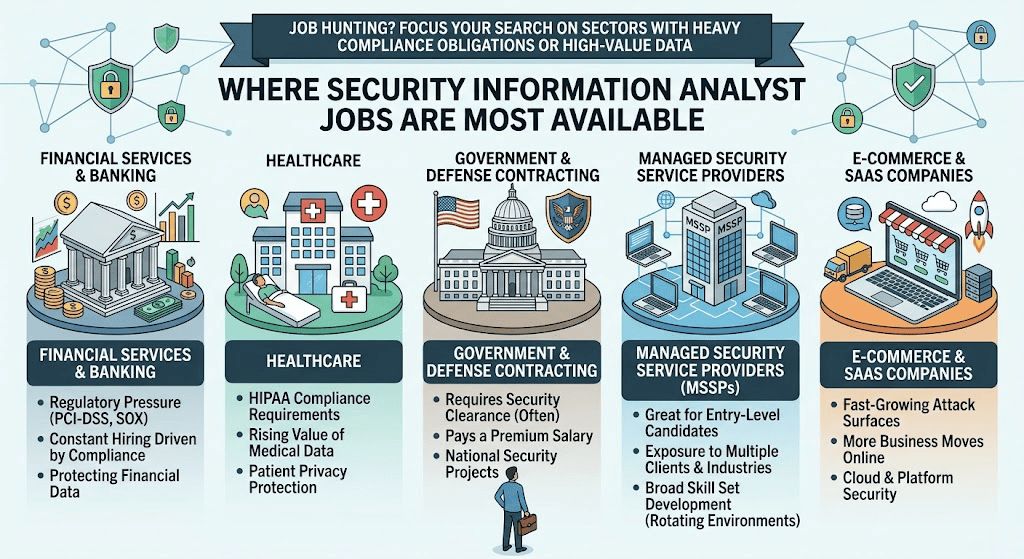
Not every industry hires at the same pace. If you’re job hunting, focus your search on sectors with heavy compliance obligations or high-value data, since they tend to maintain larger, better-funded security teams.
- Financial services and banking — regulatory pressure (PCI-DSS, SOX) drives constant hiring
- Healthcare — HIPAA compliance and the rising value of medical data on the black market
- Government and defense contracting — often requires security clearance but pays a premium
- Managed Security Service Providers (MSSPs) — great for entry-level candidates since you get exposure to multiple clients and industries at once
- E-commerce and SaaS companies — fast-growing attack surfaces as more business moves online
MSSPs in particular are worth highlighting for beginners: because you’re rotating across different client environments, you build a broader skill set faster than you would sitting inside one company’s single security stack.
Step-by-Step: How to Land Your First Security Information Analyst Job
If you’re starting from scratch — no security experience, maybe coming from a help desk or general IT role — here’s a realistic path.
- Build networking and systems fundamentals first. You cannot effectively analyze security logs if you don’t understand what normal network behavior looks like. Spend real time here before jumping to security tools.
- Get one foundational certification. Security+ is the most widely recognized starting point and signals baseline competency to recruiters using applicant tracking systems.
- Practice in a home lab or free platform. Set up a virtual SOC environment, work through TryHackMe or similar hands-on labs, and document what you learn — this becomes portfolio material.
- Learn one SIEM tool deeply rather than five superficially. Splunk offers free training and a community edition; being able to speak confidently about log analysis in one platform beats vague familiarity with several.
- Target help desk-to-SOC internal transfers if you’re already employed in IT. Many companies prefer promoting an internal candidate who already understands their environment over hiring externally.
- Tailor your resume around outcomes, not tool lists. Instead of just listing “Splunk, Wireshark, Nessus,” describe what you did with them — e.g., “Investigated and triaged 40+ daily security alerts, reducing false-positive escalations by identifying recurring patterns.”
- Prepare for scenario-based interviews. Expect questions like “How would you respond to a ransomware alert at 2 a.m.?” Practice structuring your answers around identify → contain → eradicate → recover → document.
Security Information Analyst vs. Related Titles: How to Tell Them Apart
Job titles in this field are notoriously inconsistent across companies, which makes searching confusing. Here’s a quick comparison to help you filter listings more accurately.
| Title | Primary Difference |
|---|---|
| Security Information Analyst | Broad monitoring and investigation role, often SOC-based |
| Information Security Analyst | Nearly identical scope; more common in corporate/government job postings |
| Cybersecurity Analyst | Often used interchangeably, sometimes with a slightly broader risk/compliance scope |
| Security Engineer | More hands-on with building and configuring security infrastructure, not just monitoring it |
| Penetration Tester | Offensive role — simulates attacks rather than defending against real ones |
If a posting emphasizes monitoring, log review, and incident response, it’s almost certainly describing the same core role regardless of the exact title used.
Common Mistakes Candidates Make When Applying
- Applying only to “analyst” titled roles and skipping SOC-specific postings, which are often the same job with a different label
- Listing certifications without being able to explain the underlying concepts in an interview — this gets exposed quickly
- Ignoring compliance and regulatory frameworks like GDPR, HIPAA, or PCI-DSS, which come up constantly in interviews for regulated industries
- Underestimating the importance of writing skills — incident documentation is a core deliverable, not an afterthought
- Not building any hands-on evidence — a resume with only theoretical knowledge and no lab work, CTF participation, or home projects struggles to stand out in a competitive applicant pool
Frequently Asked Questions
Do I need a computer science degree to get hired?
No. Many analysts come from IT support, network administration, or even non-technical backgrounds paired with a certification and hands-on lab practice. A degree helps but isn’t mandatory for most entry-level roles.
Is this job stressful?
It can be, particularly during active incidents or on-call rotations. However, most day-to-day work is steady monitoring and investigation rather than constant crisis mode.
How long does it take to become job-ready?
With focused study, most career switchers reach entry-level readiness in six to twelve months, combining certification study with hands-on lab practice.
Can this role be done remotely?
Yes, many SOC and analyst positions are now remote or hybrid, though some government and defense-related roles still require on-site work due to clearance requirements.
What’s the natural next step after a few years as an analyst?
Common paths include specializing (cloud security, threat intelligence, digital forensics), moving into a senior/lead analyst role, or transitioning into security engineering or management.
Final Thoughts
Security information analyst jobs sit at a genuinely useful intersection: strong demand, meaningful work protecting real organizations and people, and a clear skills-based path in that doesn’t strictly require a traditional degree. The field rewards curiosity, methodical thinking, and a willingness to keep learning as attackers change tactics.
If you’re serious about breaking in, the fastest progress comes from combining one solid certification with real hands-on practice — not from collecting a stack of credentials you can’t yet explain in an interview. Start with the fundamentals, build a small portfolio of lab work, and target SOC or analyst openings at organizations in regulated industries where hiring demand stays consistently strong.