

Explore drovenio latest technology news, including AI agents, cybersecurity, cloud computing, automation, edge AI, hardware and major technology trends shaping 2026.
Drovenio Latest Technology News: AI, Cybersecurity, Cloud Computing and the Biggest Tech Trends in 2026
Technology is moving at a pace that makes yesterday’s breakthrough feel ordinary. Artificial intelligence is becoming part of everyday software, autonomous AI agents are beginning to perform multi-step tasks, cloud platforms are becoming more intelligent, and cybersecurity teams are dealing with threats that can evolve almost as quickly as the tools designed to stop them.
That is why interest in drovenio latest technology news continues to reflect a broader need for technology information that is practical rather than simply sensational. Readers want to know what is actually changing, why it matters, and whether a new development has real consequences for businesses, developers, students, creators, and everyday internet users.
In 2026, several themes stand out. AI is moving beyond chatbots toward agents and integrated workflows. Cybersecurity is becoming an AI-versus-AI contest. Cloud infrastructure is being redesigned around AI workloads, data governance, and efficiency. At the same time, businesses are becoming more cautious about adopting technology without measuring its security, cost, and practical value.
This guide explores the major areas to watch when following drovenio latest technology news, with a focus on the developments that are likely to have lasting impact.
What Does Drovenio Latest Technology News Actually Mean?
The phrase drovenio latest technology news is best understood as a search for current information about emerging technology, digital innovation, artificial intelligence, automation, cybersecurity, cloud computing, and related developments.
Search interest around Drovenio is somewhat unusual because different websites describe Drovenio in different ways. Some online sources present Drovenio as an editorial or educational technology platform, while others use the term in connection with AI tools, digital transformation, and future technology.
For readers, the most useful approach is not to assume that every page using the Drovenio name represents an official technology company or product. Instead, evaluate individual claims based on:
- The original source of the information
- The date of publication
- Whether a company announcement or technical documentation supports the claim
- Independent reporting
- Technical evidence
- Whether the information describes a real product, research project, or prediction
This distinction is especially important in technology because AI-generated content and recycled technology stories can spread quickly.
The goal of following technology news should therefore be more than finding the newest headline. It should be understanding which developments are real, which are experimental, and which are likely to matter in the long term.
The Biggest Technology Story of 2026: AI Is Becoming More Autonomous
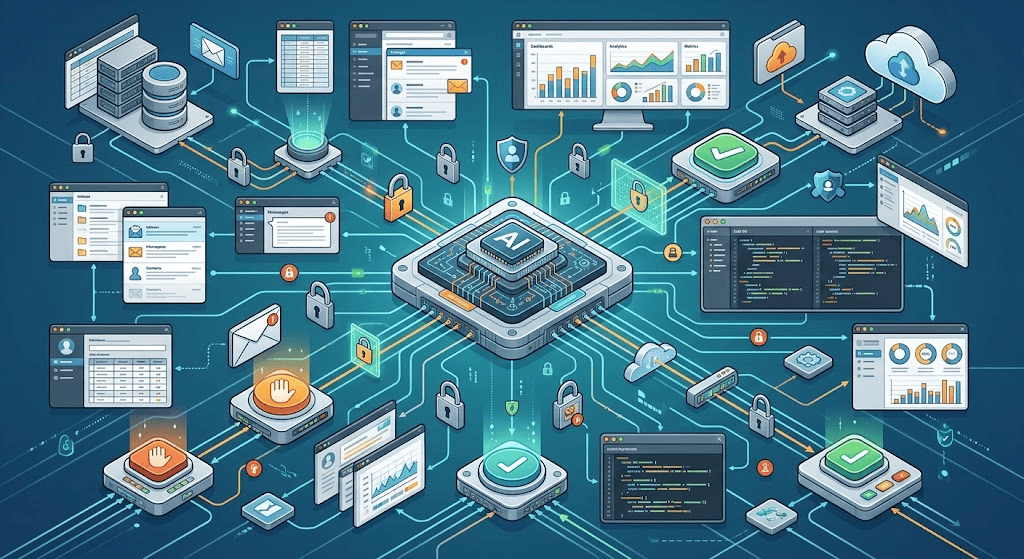
Artificial intelligence remains the central technology story of 2026, but the conversation has changed.
Earlier AI adoption focused heavily on chatbots, text generation, image creation, coding assistance, and search. The newer direction is increasingly focused on AI agents.
An AI agent is designed to do more than answer a question. Depending on its permissions and architecture, it can plan tasks, use software tools, retrieve information, execute actions, evaluate results, and continue working through a multi-step objective.
For example, instead of asking an AI system:
“Write a report about customer complaints.”
A more autonomous workflow could involve an agent retrieving complaint data, identifying recurring problems, organizing the findings, preparing a report, and sending it for human approval.
That sounds convenient, but it introduces a major challenge.
More autonomy means more responsibility
An AI system with access to email, databases, browsers, company files, APIs, or financial systems can potentially create consequences beyond producing incorrect text.
This makes permissions, monitoring, authentication, logging, and human oversight increasingly important.
Recent cybersecurity developments demonstrate why. AI systems are becoming capable of assisting both defenders and attackers, creating an environment where traditional security assumptions are being challenged. (The Guardian)
For organizations following drovenio latest technology news, the important question is therefore not simply “What can AI do?”
It is:
What should AI be allowed to do without human approval?
AI Agents Could Change the Way Software Works
The growth of AI agents could influence software design as significantly as mobile apps and cloud computing did in earlier technology cycles.
Traditional software generally requires a user to understand the interface and perform a sequence of actions.
Agent-based software can potentially turn that relationship into something more conversational and goal-oriented.
Traditional workflow
- Open an application.
- Find the correct menu.
- Enter information.
- Export a report.
- Send the report.
- Update another system.
Agent-assisted workflow
- Describe the desired outcome.
- Let the agent identify the necessary steps.
- Review the proposed actions.
- Approve sensitive operations.
- Let the system complete routine tasks.
This could be useful in customer support, accounting, marketing, software development, research, logistics, and internal administration.
However, companies need to avoid treating autonomous AI as a replacement for process design. If the underlying data is inaccurate or the workflow is poorly defined, an agent can automate bad decisions faster.
Cybersecurity Is Becoming an AI Arms Race
Cybersecurity is another major area that deserves attention in any discussion of drovenio latest technology news.

AI can help security teams identify suspicious activity, analyze large datasets, classify threats, discover vulnerabilities, and automate parts of incident response.
At the same time, attackers can use AI to improve phishing campaigns, generate malicious content, automate reconnaissance, and adapt attacks more efficiently.
This creates an uncomfortable cycle:
AI improves security. AI improves attacks. Security systems respond with more AI.
IBM’s 2026 cybersecurity reporting highlights continuing concerns around supply-chain compromises, public-facing applications, and exploitation of vulnerabilities.
The lesson for organizations is simple: adopting AI without strengthening security can create a larger attack surface.
What businesses should prioritize
Organizations introducing AI systems should consider:
- Strong identity and access management
- Least-privilege permissions
- Secure API authentication
- Data-loss prevention
- Monitoring of AI actions
- Human approval for high-risk tasks
- Regular vulnerability testing
- Prompt-injection defenses
- Detailed activity logs
- Secure handling of confidential information
Security should not be added after an AI system is deployed. It should be designed into the system from the beginning.
Cloud Computing Is Evolving Around AI
Cloud computing remains one of the foundations of modern technology, but AI is changing what businesses expect from cloud infrastructure.

AI workloads can require enormous amounts of processing power, memory, networking capacity, and specialized hardware. This has encouraged cloud providers to invest heavily in AI infrastructure and services.
At the same time, businesses are paying closer attention to cloud costs.
The old strategy of simply moving more workloads into the cloud is no longer enough. Companies increasingly need to determine:
- Which workloads should run in public cloud environments?
- Which data should remain in private infrastructure?
- Where should AI inference happen?
- How much computing capacity is actually required?
- How can organizations control data residency?
- How can cloud spending be monitored?
Google has also highlighted the increasing role of AI-powered security and agentic threat detection within its cloud strategy, illustrating how cloud infrastructure and AI security are becoming increasingly interconnected. (blog.google)
Google Cloud’s 2026 technology and AI developments
The Rise of Smaller and More Specialized AI Models
One of the most interesting developments in current AI technology is the movement toward specialized models.
Large models receive much of the public attention, but smaller models can be useful when organizations care about speed, cost, privacy, or local deployment.
A company may not need the largest possible model to classify customer requests or summarize internal documents.
A smaller model could potentially perform the task faster and more economically.
Why smaller AI models matter
| Factor | Large general model | Smaller specialized model |
|---|---|---|
| Typical cost | Higher | Lower |
| General capability | Very broad | More focused |
| Deployment | Often cloud-based | Can be easier to deploy locally |
| Latency | Can vary | Often lower |
| Customization | Broad | Strong for specific tasks |
| Privacy options | Depends on provider | Potentially better with local deployment |
This does not mean smaller models will replace frontier systems. Instead, businesses may use multiple models for different tasks.
That could lead to a more diverse AI ecosystem rather than one model being responsible for every business operation.
AI Hardware Is Becoming a Strategic Technology
Software gets most of the attention, but AI depends heavily on hardware.
Modern AI systems require specialized processors, high-bandwidth memory, fast networking, and increasingly sophisticated data-center infrastructure.
This has turned computing hardware into a strategic part of national and corporate technology policy.
Countries and major technology companies are investing in domestic AI infrastructure because access to computing capacity can influence research, economic competitiveness, defense capabilities, and industrial development.
Brazil, for example, announced a major AI supercomputing investment in 2026 involving projects using hardware and technology partnerships from both U.S. and Chinese companies. (Reuters)
This trend suggests that the AI race is not only about who builds the best model.
It is also about who has access to:
- Advanced processors
- Semiconductor manufacturing
- Data centers
- Energy
- High-speed networking
- Specialized engineering talent
- Reliable data
Automation Is Moving Beyond Simple Repetitive Tasks
Robotic process automation previously focused heavily on predictable tasks such as copying information between systems, processing forms, or generating standard reports.
AI is expanding the scope of automation.
Modern intelligent automation can potentially interpret documents, classify requests, summarize information, generate responses, and make recommendations.
For example, an insurance company could use AI to review incoming documentation before sending complex cases to human specialists.
A retailer could use automation to analyze customer feedback and identify recurring product problems.
A software company could use AI to classify bug reports and suggest possible fixes.
The biggest opportunity is not simply replacing manual work. It is reducing the time people spend on repetitive coordination so they can focus on decisions requiring judgment.
The New Challenge: AI Security Must Keep Up With AI Capability
As AI systems become more capable, security teams have to rethink how they evaluate risk.
Traditional applications generally behave according to relatively predictable instructions. AI systems can respond differently depending on input, context, retrieved information, tools, and model behavior.
That creates unique security concerns.
Important AI security risks
Prompt injection:
An attacker may attempt to manipulate an AI system through specially designed instructions.
Data leakage:
Sensitive information could potentially be exposed through poorly designed prompts, integrations, logs, or model workflows.
Excessive permissions:
An AI agent with unnecessary access can create much greater damage if compromised or manipulated.
Supply-chain risks:
AI applications often depend on external models, APIs, libraries, datasets, and third-party services.
Model manipulation:
Systems may be influenced by malicious or misleading training or retrieval data.
Organizations should therefore treat AI as part of their security architecture, not as a separate experiment.
Cloud, Edge Computing and Local AI Will Work Together
Another important trend is the combination of cloud computing with edge and local processing.
Not every AI task needs to be sent to a distant data center.
Smartphones, industrial equipment, vehicles, cameras, and other connected devices can increasingly perform processing locally.
This can provide several benefits:
- Lower latency
- Reduced bandwidth requirements
- Better privacy
- Offline functionality
- Faster responses
- Reduced dependence on cloud services
A factory, for example, may use local AI to identify equipment abnormalities in real time while sending summarized information to a central cloud platform for long-term analysis.
This hybrid model is likely to become increasingly common.
Technology Is Becoming More Focused on Practical Value
One of the clearest themes in 2026 technology discussions is a shift from experimentation toward measurable outcomes.
Businesses have spent years testing new digital tools. Now many organizations want evidence that technology produces a return.
This means technology decisions are increasingly evaluated through questions such as:
- Does this reduce operating costs?
- Does it improve customer service?
- Does it reduce security risk?
- Does it save employee time?
- Does it improve accuracy?
- Can the organization maintain it?
- Is the technology scalable?
- What happens if the provider changes its pricing?
This is important for readers because not every new technology deserves immediate adoption.
A product can be impressive in a demonstration and still be unsuitable for real-world use.
How to Evaluate Technology News Before Believing It
The amount of technology content online makes critical thinking essential.
When reading a headline about AI, cybersecurity, software, or a new device, use a simple verification process.
1. Check the date
Technology changes rapidly. A story from two years ago may describe capabilities that are no longer current.
2. Find the original announcement
If an article claims that a company launched a new product, look for the company’s announcement or documentation.
3. Separate demonstrations from products
A research prototype is not necessarily a commercially available product.
4. Look for independent confirmation
Important claims deserve confirmation from credible independent sources.
5. Check the technical details
Ask what the technology actually does rather than relying on promotional language.
6. Watch for exaggerated AI claims
Words such as “revolutionary,” “human-level,” “fully autonomous,” and “unhackable” should invite closer examination.
7. Consider limitations
A trustworthy technology article should discuss limitations as well as advantages.
This approach is especially useful when following drovenio latest technology news, because the name may appear across multiple technology-focused websites with different editorial standards.
What These Trends Mean for Everyday Users
You do not need to work in a technology company to be affected by these developments.
AI is increasingly appearing in search engines, office software, smartphones, education platforms, customer service, financial applications, and creative tools.
For everyday users, a few habits can make technology safer.
Protect your accounts
Use unique passwords and multi-factor authentication wherever possible.
Be careful with AI-generated information
AI can produce convincing but incorrect answers. Verify important claims.
Think before uploading sensitive information
Do not automatically paste private financial, business, personal, or confidential information into an AI service.
Review application permissions
If an AI application requests access to email, files, contacts, or other services, consider whether that access is genuinely necessary.
Keep software updated
Security updates often address vulnerabilities that attackers could exploit.
What Businesses Should Watch Next
The next stage of technology adoption is likely to focus on integration rather than isolated tools.
Businesses may increasingly connect AI systems with existing databases, customer relationship platforms, communication tools, software development systems, analytics platforms, and security products.
That creates a powerful opportunity, but also increases complexity.
A sensible technology roadmap should therefore include four stages:
Stage 1: Identify the problem
Start with a business problem rather than a technology trend.
Stage 2: Test the smallest useful solution
Run a controlled pilot before deploying a system across the organization.
Stage 3: Measure results
Track accuracy, cost, time saved, security incidents, and user satisfaction.
Stage 4: Scale carefully
Only expand the system after proving that it works reliably.
This approach helps prevent organizations from spending heavily on technology that looks impressive but delivers little practical value.
A Practical 2026 Technology Watchlist
For anyone who wants to stay informed about drovenio latest technology news, the following areas deserve regular attention:
| Technology area | Why it matters | What to watch |
|---|---|---|
| AI agents | Automates multi-step workflows | Permissions and reliability |
| Generative AI | Changes content and software creation | Accuracy and cost |
| Cybersecurity AI | Improves threat detection | AI-powered attacks |
| Cloud computing | Supports modern applications | Cost and data governance |
| Edge AI | Enables local intelligence | Privacy and latency |
| AI hardware | Determines computing capacity | Chips, memory and networking |
| Automation | Reduces repetitive work | Integration and oversight |
| AI governance | Controls technology risk | Regulation and accountability |
| Open models | Expand access to AI | Security and customization |
| Digital transformation | Connects technology with business processes | Measurable ROI |
Why Reliable Technology Reporting Matters
Technology reporting has become more important as new tools become increasingly influential.
A good technology article should clearly distinguish between different types of information.
Fact: A product or service has been officially launched.
Company claim: A company says its technology can perform a particular task.
Prediction: Analysts expect a technology to become important.
Experiment: Researchers have demonstrated something under controlled conditions.
Speculation: A possible future development has not yet been demonstrated.
These categories can easily become blurred online.
For that reason, readers should use multiple sources and prioritize primary documentation when making important decisions.
The most valuable drovenio latest technology news is information that provides context rather than simply repeating a headline.
The Bigger Picture: Where Technology Is Heading
The most important technology development may not be one specific product.
Instead, it is the convergence of several technologies.
AI is becoming integrated with cloud infrastructure. Cybersecurity teams are using AI to identify threats. Cloud platforms are adding intelligent security capabilities. Hardware is being redesigned around AI workloads. Automation is becoming more flexible. Edge devices are gaining local intelligence.
Together, these developments are creating an environment where software can increasingly understand information, make recommendations, interact with other systems, and perform tasks.
But greater capability also brings greater responsibility.
Organizations need stronger security controls. Users need better digital literacy. Developers need to build safeguards into systems from the beginning. Technology publishers need to distinguish evidence from speculation.
That balance will determine which innovations become genuinely useful.e which innovations become genuinely useful and which disappear after the initial excitement.
Final Thoughts on Drovenio Latest Technology News
Final Thoughts on Drovenio Latest Technology News
The technology landscape is moving from isolated innovations toward connected intelligent systems. Artificial intelligence, autonomous agents, cloud computing, cybersecurity, specialized hardware, automation, and edge computing are increasingly influencing one another.
The best way to understand drovenio latest technology news is to look beyond individual headlines and examine the broader trends connecting AI, cybersecurity, cloud infrastructure, automation, and digital transformation.
AI agents may transform workflows, but only when their permissions and limitations are properly managed. Cloud computing remains essential, but cost, privacy, and data governance matter more than ever. Cybersecurity is becoming inseparable from AI adoption, while specialized models and local processing may make intelligent technology more accessible and efficient.
The technology that ultimately matters will not necessarily be the technology with the loudest headline. It will be the technology that proves useful, secure, affordable, and reliable in the real world.
For anyone interested in drovenio latest technology news, the smartest approach is to stay curious, verify important claims, follow credible sources, and focus on developments that create measurable value.