

Learn proven Denver blog SEO tips to rank higher in Google. Covers keyword research, local SEO, E-E-A-T, AI Overviews, and on-page strategy for 2026.
Denver Blog SEO Tips: A Complete Guide to Ranking Higher in Google
If you run a blog for a Denver-based business, publish local content, or write for a company trying to reach Colorado’s Front Range audience, you already know the frustration: you hit publish, wait, and nothing moves. Meanwhile, a competitor with a thinner post outranks you in the local pack and organic results.
The gap usually isn’t effort. It’s strategy. Denver’s search landscape is more competitive than it was even two years ago, Google’s algorithm now weighs experience and technical performance more heavily, and AI Overviews are absorbing a growing share of clicks before searchers ever scroll to the blue links. Applying the right Denver blog SEO tips in this environment takes a combination of solid on-page SEO, real local relevance, and content built for how people (and AI systems) actually search today.
This guide breaks down exactly how to approach your strategy using proven Denver blog SEO tips for 2026 — from keyword research and content structure to local signals, technical health, and the questions Denver readers are actually typing into Google.
Quick Answer
To rank a Denver blog higher in Google, combine three things: content that demonstrates first-hand experience and answers a specific search intent, on-page SEO fundamentals (clear headings, one primary keyword per page, internal linking, fast load times), and local relevance signals (Denver-specific examples, neighborhood or metro-area references, and a connected, active Google Business Profile if you’re a local business). Consistency matters more than volume — a well-optimized post published every two weeks will typically outperform five rushed posts published in the same period.
Why Denver Blog SEO Is Different From Generic SEO Advice
Most SEO guides are written for a national or global audience. Denver blogs compete in a specific environment shaped by a few local realities:
- A crowded, fast-growing market: Denver’s population growth over the past decade has pulled in more service businesses, agencies, and bloggers competing for the same local search terms — from home services to fitness, real estate, and food and drink content.
- High mobile and “near me” search volume: Local intent makes up a huge share of everyday Google searches, and mobile users searching Denver-area terms tend to act quickly — often visiting or contacting a business within a day of searching.
- Google Business Profile plays a bigger role: If your blog supports a business with a physical presence or service area in Denver, your GBP listing and blog content need to reinforce each other, not compete for attention. Read more in our dedicated Local SEO for Denver Businesses guide.
- A tighter algorithmic bar for quality: Google’s core updates in 2026 have continued to reward pages that show clear expertise and a good on-page experience while pushing down thin, generic content.
None of this means Denver SEO requires exotic tactics. It means the fundamentals need to be applied with local specificity, not generic filler.
How Google Actually Ranks Blog Content in 2026
Before getting into tactics, it helps to understand what’s changed in how Google evaluates content.
Core updates now weigh technical performance more holistically. Rather than scoring Core Web Vitals metrics (loading speed, interactivity, visual stability) in isolation, Google’s more recent core updates evaluate them together. For more technical background, review the official Google Search Central documentation on core updates.
E-E-A-T (Experience, Expertise, Authoritativeness, Trust) remains central. Google has repeatedly reinforced that content quality signals tied to E-E-A-T are core to how it evaluates pages during core updates. For instance, following expert Denver blog SEO tips regarding a post about “best patios for winter dining” ranks better when it reads like it was written by someone who has actually eaten at those patios in Denver in winter — not summarized from other articles. You can also explore our client case studies and results pages to see how we demonstrate real-world authority.

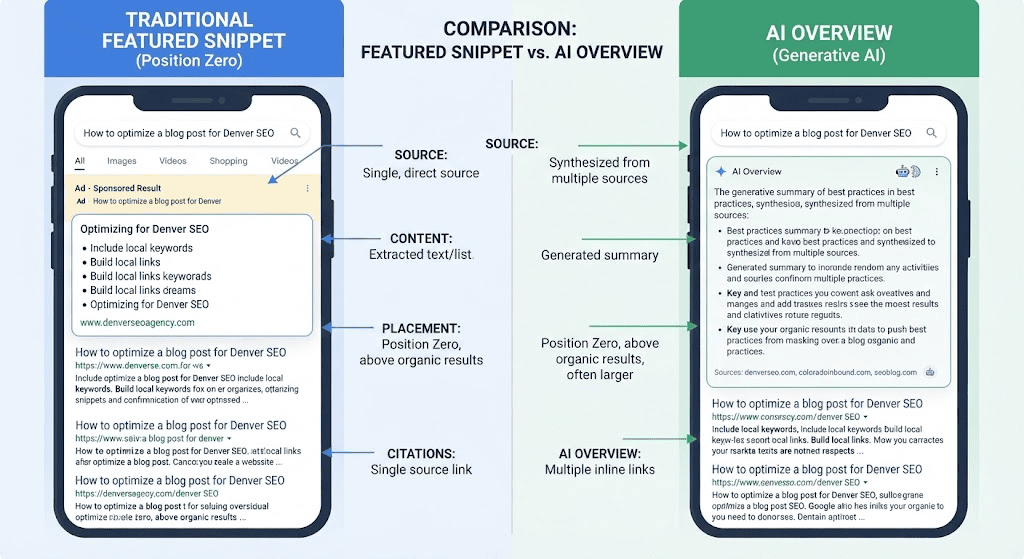
AI Overviews are now part of the search results page for a large share of queries. Estimates vary, but AI-generated summaries are showing up more often, tending to reduce raw clicks to any single organic result when they appear. The practical implication for Denver bloggers: structuring content so it can be directly quoted or summarized (clear answers, defined terms, scannable lists) increases the odds of being the source Google’s AI Overview cites.
The Denver Blog SEO Framework: 7 Core Steps
1. Start With Denver-Specific Keyword Research
Generic keyword tools will show you national search volume, which can be misleading for a local blog. The goal isn’t the highest-volume keyword — it’s the keyword with the clearest local intent that you can realistically rank for. When executing effective Denver blog SEO tips, keep these practices in mind:
- Use Google’s autocomplete and “People also ask” boxes directly from a Denver-based search.
- Layer in neighborhood- and metro-level modifiers where relevant (Aurora, Lakewood, Boulder, the Front Range, LoDo, RiNo, Cherry Creek).
- Separate your keywords into primary, secondary, and long-tail tiers.
2. Match Search Intent Before You Match Keywords
A page can be perfectly keyword-optimized and still fail to rank if it doesn’t match what searchers actually want. A post titled “Denver Blog SEO Tips” is informational, so it should read like a genuinely useful guide, not a disguised sales pitch.
3. Structure Content for Featured Snippets and AI Overviews
- Open each major section with a direct, two-to-three sentence answer.
- Use descriptive H2 and H3 headings phrased as questions.
- Use numbered lists for processes and bullet lists for comparisons.
4. Build Real Local Relevance, Not Just Local Keywords
Local relevance is a trust signal, not just a keyword placement exercise. Reference specific, verifiable local details like neighborhoods or seasonal weather swings. Keep your business name, address, and phone number consistent across your site and your listing, following Google’s official guidance on Google Business Profile optimization.
5. Fix the Technical Foundation
No amount of good writing overcomes a slow, unstable, or hard-to-crawl site. Learn how to diagnose your site metrics in our deep-dive on Google Core Web Vitals Explained.
6. Publish Consistently — and Update What You Already Have
Posting frequency matters less than consistency and freshness.
- A practical cadence for most Denver small business blogs is one well-researched post every one to two weeks.
- Use a structured workflow outlined in our guide on How to Plan a Blog Content Strategy.
- Routinely update older content with fresher information.
7. Track the Right Metrics
Rankings alone don’t tell the full story anymore. Track organic impressions and click-through rates using tools like Google Search Console, and monitor ongoing algorithm shifts via industry benchmarks from publishers like Search Engine Journal.
Comparison Table: Denver Blog SEO Priorities by Business Type
| Business Type | Top Priority | Secondary Priority | Common Mistake to Avoid |
| Local service business | Google Business Profile alignment | Blog posts answering local questions | Treating the blog as separate from the GBP |
| E-commerce / product brand | Long-tail, intent-matched blog content | Internal linking to product pages | Writing generic buying guides without testing |
| Media / publisher | Topical authority & consistency | Backlinks from Colorado publications | Chasing trending topics with no search value |
| Professional services | Demonstrated expertise & credentials | FAQ content optimized for snippets | Vague, generic advice without local examples |
Practical Example: Optimizing a Single Denver Blog Post
Say you’re writing a post targeting “best coworking spaces in Denver.”
- Primary keyword: best coworking spaces in Denver
- Search intent: Commercial investigation — readers are comparing options before choosing.
- Structure: Open with a two-sentence direct answer, followed by a short comparison table of 5–8 spaces with location, price range, and standout features.
- Local relevance: Mention actual neighborhoods (RiNo, LoDo, Capitol Hill) and practical local details like parking or transit access.
- E-E-A-T signal: Note if you or a contributor actually worked from these spaces.
- Schema: Consider Article schema combined with FAQ schema.
Pros and Cons of Common Denver Blog SEO Tactics
- Aggressive local keyword stuffing:
- Pros: Feels intuitive; easy to do.
- Cons: Reads unnaturally and can look manipulative to Google’s quality systems.
- Publishing very frequently with short, thin posts:
- Pros: More indexed pages quickly.
- Cons: Thin content is filtered out by recent quality-focused updates.
- Investing in fewer, deeper, well-researched posts:
- Pros: Better positioned for AI Overviews and featured snippets; earns more backlinks.
- Cons: Requires more upfront research time.
- Local link-building through genuine partnerships:
- Pros: Strong trust signal that compounds over time.
- Cons: Harder to scale and requires authentic relationship-building.
Final Verdict
Implementing the right Denver blog SEO tips in 2026 isn’t about finding a shortcut — it’s about applying fundamental SEO practices with genuine local specificity and enough depth to satisfy Google’s quality-focused algorithm. Combine intent-matched keyword targeting with consistent local relevance, fast page speeds, and up-to-date content, and your Denver blog can realistically compete even in a crowded market.
FAQs
How often should a Denver business blog post for SEO?
There’s no fixed rule, but consistency matters more than frequency. One thorough, well-optimized post every one to two weeks, paired with regular updates to existing posts, tends to outperform frequent but thin publishing.
Do I need to mention “Denver” repeatedly for local SEO to work?
No. Repeating a location name excessively can look manipulative. It’s more effective to include specific, accurate local details naturally within genuinely useful content.
Does blogging actually help local SEO, or is Google Business Profile enough?
Both matter, and they reinforce each other. Google Business Profile signals are central to local pack rankings, but a blog builds broader topical authority and can rank for informational queries that a GBP listing alone cannot capture.
How long should a blog post be to rank well in 2026?
Length should be driven by how thoroughly the topic needs to be covered, not a fixed word count. Comprehensive posts tend to earn more backlinks, but padding content can hurt readability.
What is E-E-A-T and why does it matter for a Denver blog?
E-E-A-T stands for Experience, Expertise, Authoritativeness, and Trust. For a local blog, this means showing first-hand, specific knowledge of Denver and being transparent about who wrote the content.
How do AI Overviews affect blog traffic, and should I still bother with SEO?
AI Overviews appear on a meaningful share of searches and can reduce click-through rates. However, being cited within an AI Overview is associated with higher click-through rates compared to not being cited at all — making well-structured SEO content vital.
What’s the biggest local SEO mistake Denver bloggers make?
Treating “local” as a keyword modifier rather than a genuine content strategy — inserting “Denver” into a generic post instead of writing something that required local knowledge to produce.
Should I use schema markup on my Denver blog posts?
Yes, where relevant. Article schema and FAQ schema apply directly to blog content, and LocalBusiness schema is valuable on core business pages.
How do I know if my blog SEO strategy is actually working?
Track more than rankings: monitor organic impressions and click-through rates in Google Search Console, watch which pages earn backlinks, and monitor Google Business Profile actions.