
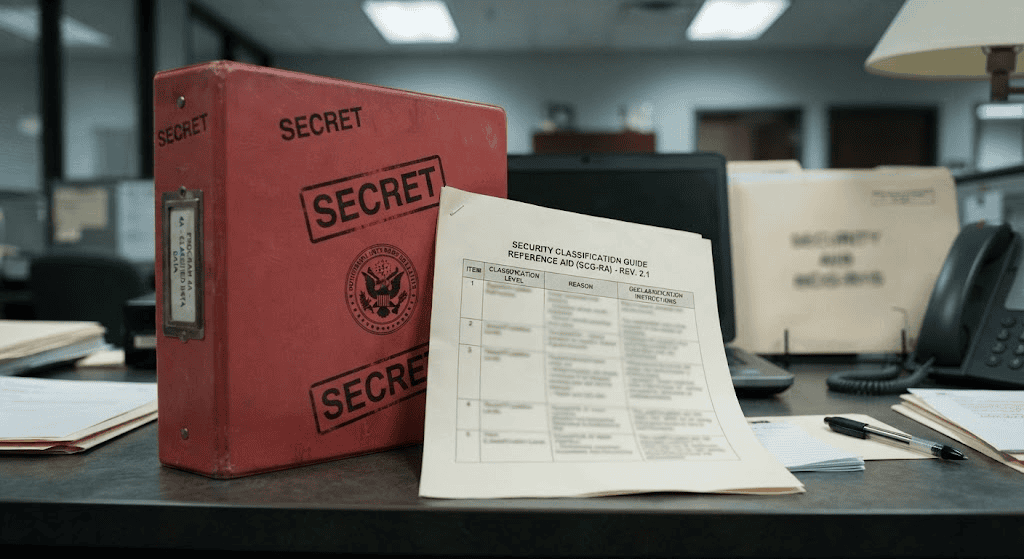
What is a security classification guide? Learn its meaning, purpose, who creates it, and real examples of how it protects classified information.
What Is a Security Classification Guide? Meaning, Purpose & Examples
If you’ve ever worked around classified information, government contracts, or defense programs, you’ve probably heard the term thrown around in a meeting without much explanation. So — what is a security classification guide, exactly?
In simple terms, a security classification guide (SCG) is an official document that tells people handling information about a specific program, project, or system exactly which pieces of that information are classified, at what level, and for how long. It’s the rulebook that keeps classification decisions consistent, instead of leaving them up to guesswork from whoever happens to be writing a report that day.
This guide breaks down what a security classification guide actually is, who creates one, what goes inside it, how it’s used day to day, and how it compares to related security documents — with practical examples throughout.
Security Classification Guide: Quick Definition
A security classification guide is a documentary tool, issued by an Original Classification Authority (OCA), that identifies specific elements of information related to a program, project, system, or mission that require classification. It sets the classification level (Confidential, Secret, or Top Secret), the reason for classification, and the duration — meaning when, if ever, the information can be downgraded or declassified.
The U.S. Department of Defense describes the purpose plainly in its own guidance for developing these documents: DoD guidance for developing security classification guidance reissues instructions for developing security classification guidance pursuant to Executive Order 13526 and related federal regulations.
Put another way — an SCG doesn’t classify the whole program as one giant secret. It breaks the program down into specific facts, capabilities, or details and assigns a classification decision to each one individually.
Why Security Classification Guides Exist
Without a clear guide, classification becomes inconsistent. One analyst might mark a detail as Secret, while another treats the same type of information as unclassified. That inconsistency creates two serious risks:
- Overclassification, which wastes security resources protecting information that doesn’t need it and makes information sharing harder than necessary
- Underclassification, which risks exposing sensitive details that genuinely could damage national security if disclosed
The Department of Defense’s own handbook on this topic makes the reasoning explicit: good security classification practice calls for the timely issuance of comprehensive guidance regarding the classification of information whose unauthorized disclosure could reasonably be expected to cause damage to national security, and precise classification guidance is a prerequisite for effective and efficient information security.
In short, an SCG exists so that classification decisions are:
- Consistent across every person and organization working on the same program
- Defensible, with a documented rationale behind each classification decision
- Reviewable, so guidance can be updated as a program evolves or matures
- Efficient, protecting only what genuinely needs protection
Who Creates a Security Classification Guide?
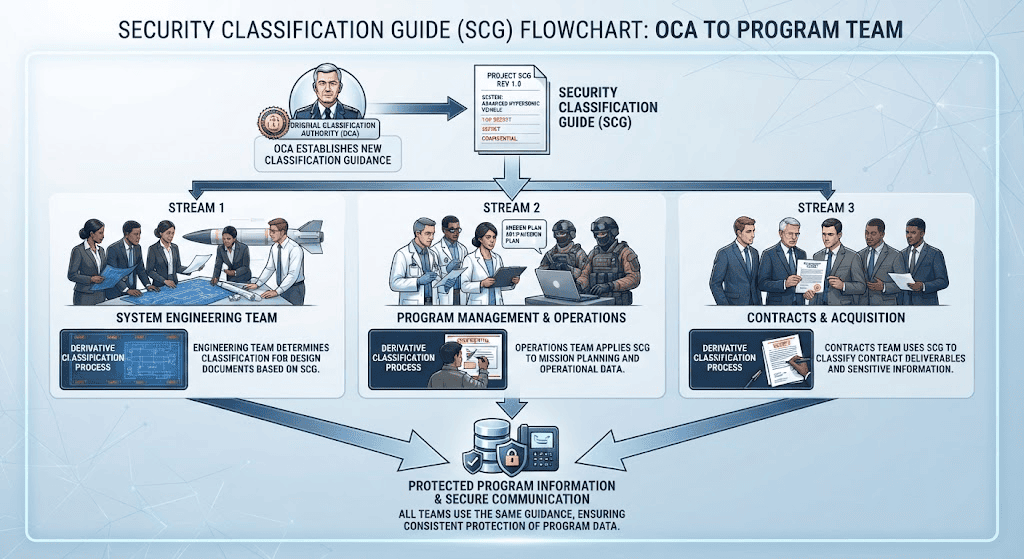
Only an Original Classification Authority (OCA) can issue a security classification guide. An OCA is a government official specifically delegated the authority to make original classification decisions — meaning they determine, for the first time, that a specific piece of information requires protection in the interest of national security.
This is different from derivative classification, where someone applies classification markings to a new document because it incorporates information already covered by an existing SCG or classified source. Most people who touch classified material in their day-to-day work are derivative classifiers, not OCAs — which is exactly why the SCG exists: it gives them the instructions they need without requiring original classification authority themselves.
Typical OCAs include senior officials within:
- Military service branches and combatant commands
- Defense agencies and program offices
- Intelligence community organizations
- Certain federal civilian agencies with national security equities
What’s Inside a Security Classification Guide?
Every SCG is built around breaking a program or system into individual elements of information, then assigning classification instructions to each one. While formatting varies by agency, most guides include the same core components.
| Component | What It Covers |
|---|---|
| Item/element description | The specific fact, capability, or piece of information being classified |
| Classification level | Confidential, Secret, or Top Secret |
| Reason for classification | The category of harm disclosure could cause (e.g., military plans, intelligence sources, foreign relations) |
| Declassification instructions | Date, event, or “exempt” status determining when the item may be declassified |
| Special markings/caveats | Dissemination controls, compartments, or handling caveats, if applicable |
| Remarks | Context, exceptions, or notes clarifying how to apply the guidance |
A Simplified Example
Imagine an SCG for a hypothetical defense communications system. A single entry might look something like this:
- Item: Specific frequency ranges used for secure satellite uplink
- Classification: Secret
- Reason: Disclosure would reveal military capabilities that could be exploited
- Declassification: Upon program cancellation or after 25 years, whichever comes first
- Remarks: Does not apply to publicly available commercial frequency standards referenced in open literature
This kind of itemized structure is what lets two different people, working on two different documents years apart, arrive at the same classification decision for the same type of information.
Security Classification Guide vs. Other Security Documents
People often confuse an SCG with other classification-related paperwork. Here’s how they differ.
SCG vs. Classification Markings
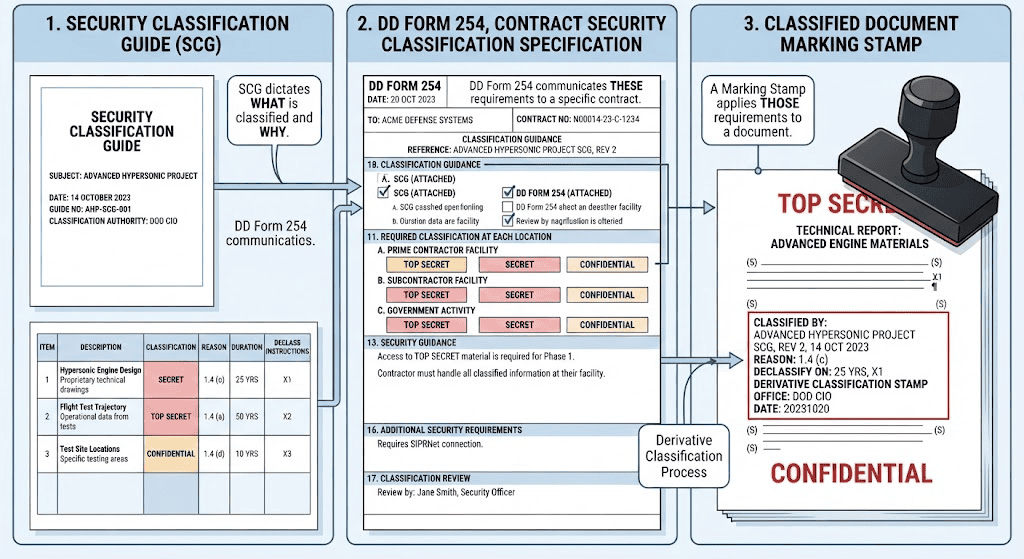
Classification markings (like “SECRET” stamped on a document) are the result of applying an SCG’s instructions. The SCG is the guidance; the marking is the outcome of following that guidance on an actual document.
SCG vs. DD Form 254
A DD Form 254 (Contract Security Classification Specification) is used specifically in contracting — it tells a contractor what classified access and safeguarding requirements apply to a particular contract. It often references the applicable SCG rather than replacing it. Contractors still need the underlying SCG to know exactly what information within their work is classified.
SCG vs. a Security Classification System
A classification system (Confidential, Secret, Top Secret) is the overall framework of levels. An SCG applies that framework to specific, real information tied to one program. Think of the classification system as the alphabet and the SCG as the actual sentence written using that alphabet for a specific subject.
SCG vs. Non-Disclosure Agreement (NDA)
An NDA is a legal agreement an individual signs, acknowledging their obligation to protect classified information. It doesn’t tell them what is classified — that’s the SCG’s job.
How Security Classification Guides Are Used in Practice
An SCG isn’t a document people read once and forget. It’s a working reference used continuously throughout a program’s lifecycle.
1. During Program Planning
Program managers and security officers work with the OCA early on to identify what aspects of a new system, plan, or mission genuinely warrant classification, avoiding blanket overclassification from day one.
2. During Document Creation
Writers, engineers, and analysts consult the SCG whenever they’re producing a report, briefing, or technical document, checking each piece of information against the guide to determine the correct classification and markings.
3. During Contract Performance
Contractors working on classified programs receive the applicable SCG (often through their DD Form 254), so their teams can properly classify deliverables, technical data, and correspondence.
4. During Periodic Review
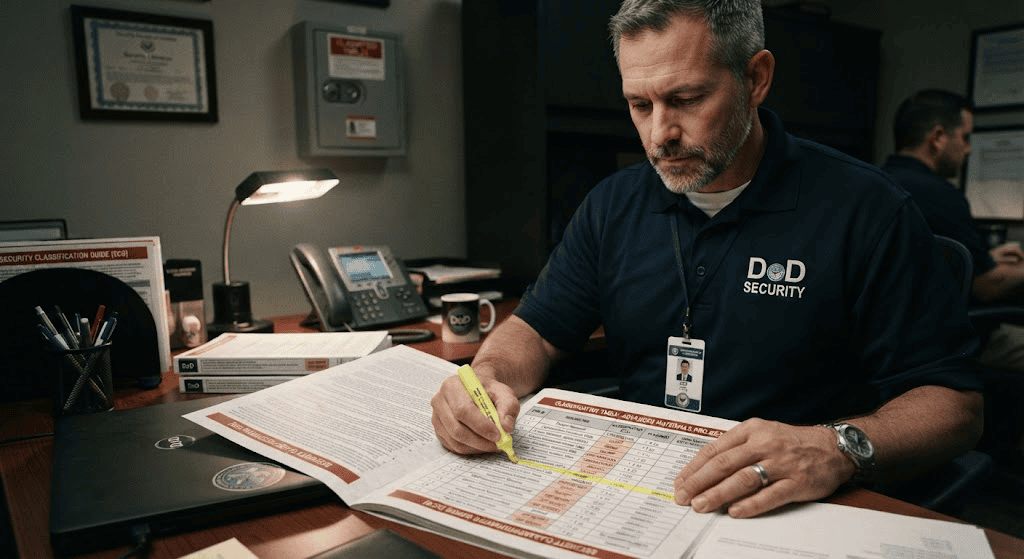
Federal policy requires periodic review of classification guidance to ensure it still reflects current program realities. Under DoD instructions, OCAs must review security classification guidance issued under their authority once every five years to ensure currency and accuracy, or sooner when significant changes occur, and must revise the guides whenever necessary for effective derivative classification</cite>. This periodic review keeps the guide accurate as technology, threats, and program details evolve.
5. During Declassification
When information reaches its declassification date, or a program is canceled and no longer holds classified value, the SCG’s declassification instructions determine what can be released and when.
How a Security Classification Guide Is Developed
Writing an effective SCG takes coordination between program experts and trained classification management personnel. The general process looks like this:
- Identify the OCA responsible for the program, system, or mission requiring guidance
- Break the program down into discrete elements of information (capabilities, technical parameters, vulnerabilities, sources, methods, etc.)
- Evaluate each element against classification criteria — does disclosure reasonably risk damage to national security, and if so, at what level of damage?
- Assign a classification level and duration to each element, backed by a documented rationale
- Draft the guide in a clear, itemized format that non-specialists can apply consistently
- Coordinate review with legal, technical, and security stakeholders before the OCA formally issues it
- Distribute the guide to everyone with a need to know, including relevant contractors
- Schedule periodic reviews to keep the guidance current as the program develops
Federal guidance from the Information Security Oversight Office (ISOO) — the agency responsible for overseeing government-wide classification policy — publishes a dedicated handbook walking OCAs and classification managers through this exact process, along with baseline guidance agencies can adapt to their own needs.
Common Mistakes in Security Classification Guidance
Even experienced organizations run into recurring issues when developing or applying SCGs:
- Vague item descriptions that leave room for interpretation instead of clear, specific classification decisions
- Missing declassification instructions, leaving information classified indefinitely by default
- Failing to update the guide as a program changes, leading derivative classifiers to apply outdated rules
- Overclassifying by default “just to be safe,” which increases cost and slows down legitimate information sharing
- Not distributing the guide widely enough, so contractors or partner agencies end up guessing at classification decisions
- Ignoring the review cycle, resulting in guidance that no longer matches current threats or technology
A 2022 Department of Defense Inspector General audit specifically examined whether components were developing and maintaining SCGs properly, underscoring how easily these documents can fall out of date without disciplined oversight and periodic review.
Who Needs to Understand Security Classification Guides?
While OCAs are the only ones who can issue an SCG, a much broader group of people need to understand and apply one correctly:
- Derivative classifiers — anyone marking new documents based on classified source material
- Program managers — who need to know what information about their program is sensitive
- Contracting officers and facility security officers — who ensure contractors receive and apply the correct guidance
- Engineers, analysts, and technical writers — who produce documents containing potentially classified details
- Auditors and Inspectors General — who verify classification guidance is accurate and properly maintained
Under federal regulations governing classification oversight, original classification authorities receive detailed training on proper classification and declassification, with an emphasis on avoiding over-classification, covering topics including security classification guides among other core classification standards. This training requirement reflects just how central SCGs are to the entire federal classification system — they aren’t a side document; they’re the operational core of how classification actually functions day to day.
Frequently Asked Questions
Is a security classification guide the same as a classified document?
No. An SCG is guidance about how to classify information — it’s typically classified itself at whatever level is needed to protect its content, but its purpose is instructional, not to convey the underlying classified facts directly to a general audience.
Who can create a security classification guide?
Only an Original Classification Authority (OCA) — a government official specifically delegated original classification authority — can issue one.
How often must a security classification guide be reviewed?
Under Department of Defense policy, SCGs must be reviewed at least once every five years, or sooner if the program changes significantly.
Do private companies need to follow security classification guides?
Yes, if they work on classified government contracts. Contractors receive applicable SCGs (often referenced through a DD Form 254) and must apply them when handling or generating classified information.
What happens if an SCG is outdated?
Outdated guidance can lead to inconsistent classification decisions, unnecessary overclassification, or accidental underclassification of sensitive details — which is why periodic review and updates are a formal requirement, not an optional best practice.
Can information in an SCG ever be declassified?
Yes. Every properly written SCG includes declassification instructions — a specific date, triggering event, or exemption — determining when each classified element can eventually be released.
Conclusion
So, what is a security classification guide? It’s the document that turns broad classification policy into specific, actionable instructions for a single program, system, or mission. By breaking information down into individual elements — each with its own classification level, justification, and declassification timeline — an SCG keeps classification decisions consistent, defensible, and efficient across everyone who touches that program, from government officials to contractors. Understanding how these guides work, who creates them, and how they’re maintained is essential for anyone operating in a classified environment, whether you’re drafting technical reports, managing a defense contract, or simply trying to make sense of the paperwork behind national security protection.