

See 50 real examples of good blog comments plus practical tips for writing comments that add value, build relationships, and get noticed by blog owners.
Good Blog Comments: 50 Examples and Tips for Writing Valuable Comments
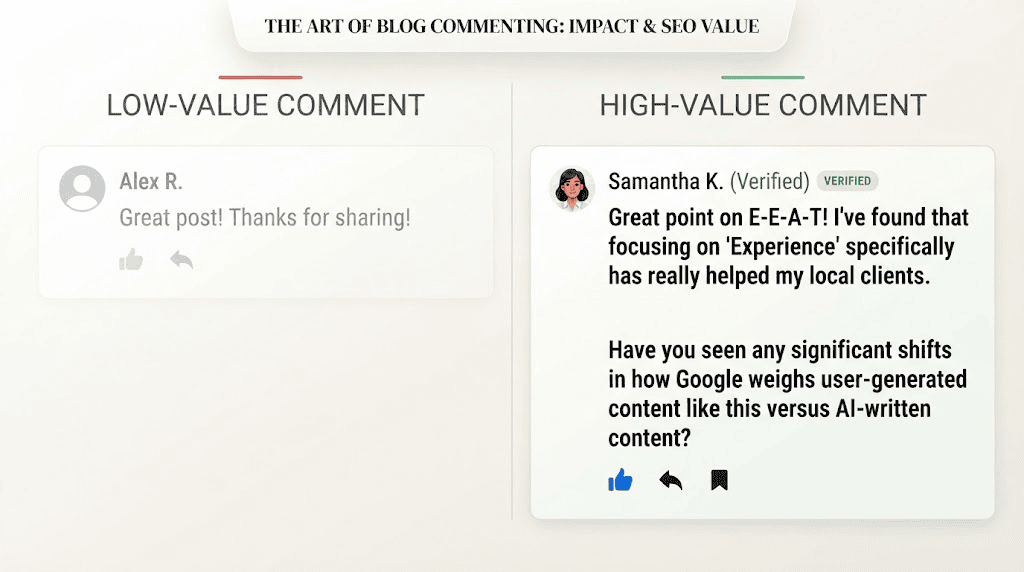
Most blog comments say nothing. “Great post!” “Thanks for sharing!” “Very informative.” They take five seconds to write and add zero value to the conversation — which is exactly why blog owners scroll past them, delete them, or mark them as spam.
A good blog comment is different. It reads the post, adds something the post didn’t already say, and makes the writer (or another reader) glad it’s there. That’s a skill, and it pays off whether your goal is building relationships in your industry, growing visibility for your own site, or just being a more useful participant in the communities you’re part of.
This guide walks through what actually makes a comment good, why it matters beyond SEO, and — because examples teach faster than rules — 50 real-style examples you can adapt across different situations: complimenting well, asking sharp questions, adding expertise, disagreeing respectfully, and more. (You can also check out our detailed guide on how to write engaging content for your blog to improve your overall outreach strategy).
Quick Answer
A good blog comment adds specific value the post didn’t already provide — a personal experience, a clarifying question, a relevant data point, a respectful counterpoint, or a useful resource — instead of generic praise. It’s short enough to read in a few seconds, directly tied to something specific in the post (not generic enough to paste anywhere), and written to be helpful to the author or other readers, not primarily to promote a link. Blog comment links are almost always tagged nofollow or rel="ugc" today, so the real value of commenting well comes from visibility, relationships, and referral traffic — not direct link-building.
Why Blog Comments Still Matter in 2026
It’s worth being honest about what blog comments do and don’t do for you, because a lot of outdated advice still circulates.
They rarely pass direct SEO ranking value anymore. The vast majority of blog comment links today are tagged nofollow or rel="ugc" — a Google-recommended attribute specifically for user-generated content like comments and forum posts. Google treats these as hints, not directives, but the practical result is the same: link-building through blog comments is not an effective SEO strategy on its own, and hasn’t been for years.
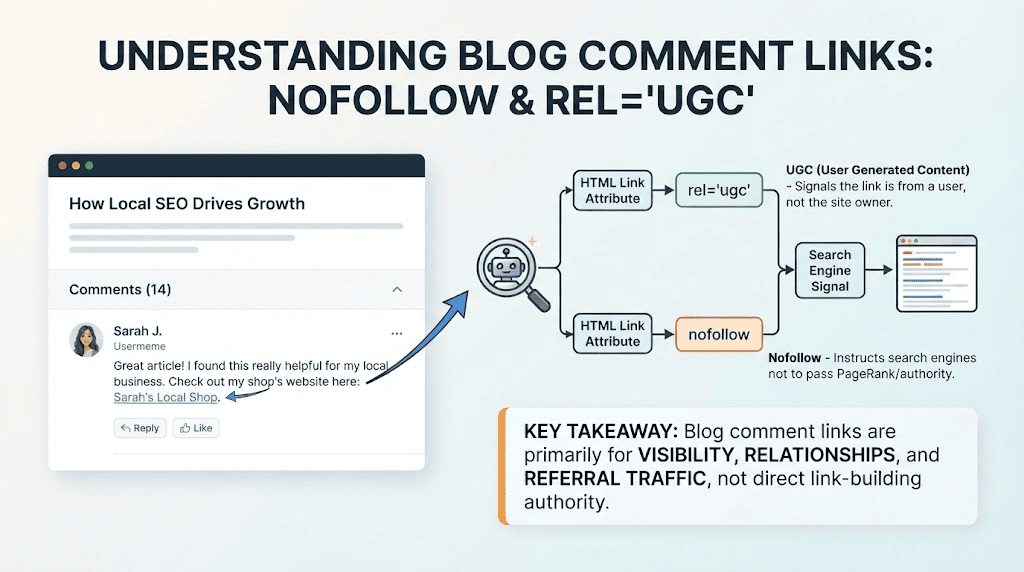
They can still indirectly support a page’s SEO. The vast majority of blog comment links today are tagged nofollow or rel=”ugc” — a Google-recommended attribute specifically for user-generated content like comments and forum posts (learn more about these guidelines directly on the Google Search Central Blog).
They’re genuinely useful for visibility and relationships. A thoughtful comment on an active industry blog gets seen by the author, other engaged readers, and sometimes future visitors who read the comment thread. That visibility can lead to referral traffic, professional connections, guest post opportunities, or being recognized as a credible voice in a niche — all of which matter more sustainably than a nofollow link ever would.
They require moderation discipline from blog owners. Spammy, irrelevant, or bot-generated comments can hurt a page’s quality signals if left unmoderated, which is why most well-run blogs use spam filters and manual approval for first-time commenters. Writing a genuinely good comment is also the easiest way to make sure yours gets approved and published in the first place.
What Makes a Blog Comment Actually Good
Before the examples, it helps to break down the anatomy of a comment that works — for the reader, the author, and (if you’re commenting to build your own presence) for you.
1. It’s specific to the post, not generic
A comment that could be pasted under any article on the internet (“Great tips, thanks!”) signals to both readers and moderators that you didn’t really engage with the content. A good comment references something specific — a stat, an example, a section heading, a claim you agreed or disagreed with.
2. It adds something new
It adds something new: The best comments extend the post with a related experience, a counterexample, a clarifying detail, or a resource that fills a gap. (For tips on structuring unique insights, read this comprehensive Copyblogger Guide on Content Engagement).
3. It’s appropriately short
Value doesn’t require length. Some of the best comments are two or three sentences. Long comments can be valuable too, but only if every sentence earns its place — padding a comment to look thorough is as unhelpful as a one-line “nice post.”
4. It’s respectful, even in disagreement
Disagreeing with a post is one of the most valuable things a comment can do, because it opens a real discussion — but it only works if it’s framed constructively rather than as a takedown.
5. It doesn’t lead with self-promotion
Mentioning your own site, product, or content is fine when it’s genuinely relevant to the discussion — but it should come second, after you’ve contributed something useful, not as the entire point of the comment.
People Also Ask: Quick Answers
What is an example of a good blog comment?
“This matches what we saw when we tested a similar approach last year — the biggest difference for us was in how quickly load time dropped after the CDN change. Did you test this on a site with a lot of embedded video, or mostly text-based pages?” This works because it’s specific, adds a real data point, and asks a genuine follow-up question.
Do blog comments help SEO?
Not in the traditional link-building sense. Most comment links are nofollow or ugc-tagged, so they don’t pass ranking authority, though they can support engagement signals (you can read more about link attributes on Ahrefs SEO Blog).
Should I include a link in my blog comment?
Only if it’s genuinely relevant to the discussion and adds value for other readers — for example, linking to a related resource or your own directly relevant case study. Leading with a link and little else usually reads as spam and gets removed.
50 Examples of Good Blog Comments
The examples below are organized by the type of value they add. Each one is written to be adaptable — swap in your own topic, experience, or question, but keep the underlying structure: specific, relevant, and additive.
Comments That Add a Specific Insight or Detail
- “One thing worth adding: this only holds for sites on a CDN. We saw very different results on a standard shared host.”
- “This lines up with what Google’s own documentation says about how this signal is weighted — worth linking for anyone who wants the primary source.”
- “Good breakdown. I’d add that this changes slightly for mobile-first indexed sites, since the crawl behavior isn’t identical.”
- “This is the clearest explanation of this concept I’ve seen — the distinction in the third section is the part most guides skip.”
- “Small correction: the tool referenced here changed its free-tier limits a few months ago, so readers should double-check current pricing before relying on this comparison.”
Comments That Share a Relevant Personal Experience
- “We implemented almost exactly this process last quarter. The part that surprised us was how much longer the migration took than planned — about three weeks instead of one.”
- “I tried the opposite approach for about six months before switching to what you’re describing here. The change in results was noticeable within the first month.”
- “This mirrors my experience almost exactly, except I found the setup step took longer than described — probably worth flagging for beginners.”
- “As someone who’s done this for a small local business rather than an enterprise site, I can confirm the core advice holds, but the budget and timeline look very different at our scale.”
- “I ran a version of this test on my own site last year and got a similar directional result, though the magnitude was smaller.”
Comments That Ask a Thoughtful, Specific Question
- “Did you test this across different content types, or mainly on long-form blog posts?”
- “How long after making this change did you start seeing measurable results?”
- “Would this approach still apply to a site with a much smaller existing backlink profile, or does it assume some baseline authority?”
- “Is there a reason you’d recommend this over the alternative method mentioned in [related topic], or do they solve different problems?”
- “What would you consider the minimum sample size before trusting a result like this?”
Comments That Respectfully Disagree or Add Nuance
- “I’d push back slightly on this point — in my experience, it depends heavily on the platform, and the advice here reads a bit more universal than I think it actually is.”
- “This is a fair summary of the general advice, but I think it undersells how much industry context matters here. What works for e-commerce doesn’t always translate to B2B.”
- “I see this differently based on recent testing — the effect described here seems to have weakened somewhat over the past year, at least in the data I’ve reviewed.”
- “Respectfully, I think this recommendation is a few years out of date. The platform changed its default behavior fairly recently, which changes the calculation.”
- “This is close, but I’d frame it slightly differently: it’s not that the tactic stopped working, it’s that it stopped being differentiating once everyone started doing it.”
Comments That Point Out a Gap or Ask for Clarification
- “This is helpful, but I think it’s missing a note about how this applies to sites using a headless CMS — worth a follow-up post, maybe?”
- “One thing that would make this even more useful: an example of what this looks like when it goes wrong.”
- “Could you clarify what you mean by ‘significant improvement’ here — is that based on a specific percentage or just general impression?”
- “This section assumes readers already know what [term] means — might be worth a quick definition for anyone newer to the topic.”
- “Curious whether this recommendation changes for very small sites versus larger ones, since the tradeoffs seem different at scale.”
Comments That Add a Useful Resource (Without Spamming)
- “For anyone who wants the primary source on this, Google’s own documentation covers it directly and is worth reading alongside this post.”
- “This pairs really well with [related concept] — if anyone hasn’t looked into that yet, it fills in a gap this post doesn’t cover.”
- “There’s a solid case study on this exact scenario that goes into more technical depth, if anyone wants to go further than this overview.”
- “Adding a note for anyone testing this themselves: the official changelog for this tool documents exactly when this behavior changed.”
- “If you found this useful, the follow-up discussion on this happened in a fairly detailed forum thread that’s worth a read.”
Short but Specific Comments (Value Doesn’t Require Length)
- “The example in section three is exactly the use case I needed clarified — thank you.”
- “This is the first explanation of this that’s actually made it click for me.”
- “Bookmarking this — the comparison table alone is worth the read.”
- “Appreciate you including the caveat about when this doesn’t apply. Too many guides skip that.”
- “This changed how I’m going to approach my next project. Specifically the point about sequencing the steps differently.”
Comments From an Industry or Subject-Matter Expert Adding Context
- “As someone who’s worked on the platform side of this, I can confirm the behavior described here is accurate, though it’s had a few quiet adjustments over the past year.”
- “This tracks with what we’re seeing across client accounts — though the timeline to results varies more by industry than most guides acknowledge.”
- “Speaking from the compliance side, this is a solid summary, but worth noting the regulatory requirements differ by state, which isn’t mentioned here.”
- “I’ve reviewed a lot of case studies on this exact topic, and this is one of the more balanced takes — most either oversell or dismiss the tactic entirely.”
- “This is consistent with the data I’ve seen across a larger sample, for what it’s worth — the pattern described here isn’t an outlier.”
Comments That Build Genuine Relationships or Community
- “Following your work on this topic for a while now — this is one of the clearer breakdowns you’ve written.”
- “This is a great follow-up to the piece you wrote a few months back on the same subject — nice to see the update.”
- “Really appreciate you writing this up in plain language. A lot of technical explanations skip exactly the part you clarified here.”
- “This is a helpful addition to the ongoing discussion in this space — curious if you’re planning a follow-up on the related edge cases.”
- “Sharing this with a few people on my team who were asking about exactly this last week.”
Comments on Tutorials, How-To Posts, or Technical Content
- “Followed this step by step and it worked exactly as described — the one place I got stuck was the permissions step, which might be worth a screenshot for beginners.”
- “This solved an issue I’d been troubleshooting for a while. The part about checking the configuration file first saved me a lot of time.”
- “Small tip for anyone following along: back up your existing settings before step four, just in case something doesn’t apply cleanly to your setup.”
- “This tutorial is more current than most others I found on the same topic — the older guides don’t account for the interface changes.”
- “Ran into an error at this step that wasn’t covered here — turned out to be a version mismatch, in case it helps someone else troubleshooting the same thing.”

Comparison Table: Weak Comments vs. Strong Comments
| Weak Comment | Why It Falls Short | Strong Alternative |
|---|---|---|
| “Great post, thanks for sharing!” | Generic, could apply to any post, adds nothing | “The point about sequencing this before scaling is one I hadn’t considered — matches an issue we ran into last quarter.” |
| “Check out my site for more on this topic.” | Leads with self-promotion, no engagement with the content | “This connects to something I wrote about recently on a related edge case — happy to share if useful, but wanted to add here that…” |
| “I disagree.” | No reasoning, adds friction without value | “I’d push back slightly here — in my experience this depends heavily on [specific factor], which isn’t addressed above.” |
| “Nice article!!!” | Low effort, often flagged as spam by moderation filters | “The comparison table made this much easier to follow than most explanations I’ve read on this topic.” |
| “First!” or unrelated link drop | Off-topic, frequently auto-removed | Any comment that references a specific detail from the post |
Practical Use Cases: When Commenting Well Actually Pays Off
- Building industry visibility: Consistently leaving thoughtful comments on well-read blogs in your niche can establish you as a recognizable, credible voice over time — which sometimes leads to guest post invitations or collaboration opportunities.
- Supporting your own content strategy: If you’ve written something genuinely relevant to a discussion, referencing it briefly (after adding real value) can drive qualified referral traffic, even without SEO benefit from the link itself.
- Customer and community goodwill: For businesses, commenting helpfully on industry publications or local community blogs builds brand association with expertise, separate from any direct marketing effect.
- Learning in public: Asking sharp, specific questions in comment sections is one of the more underrated ways to deepen your own understanding of a topic while contributing to the discussion for other readers.
How to Choose the Right Type of Comment for the Situation
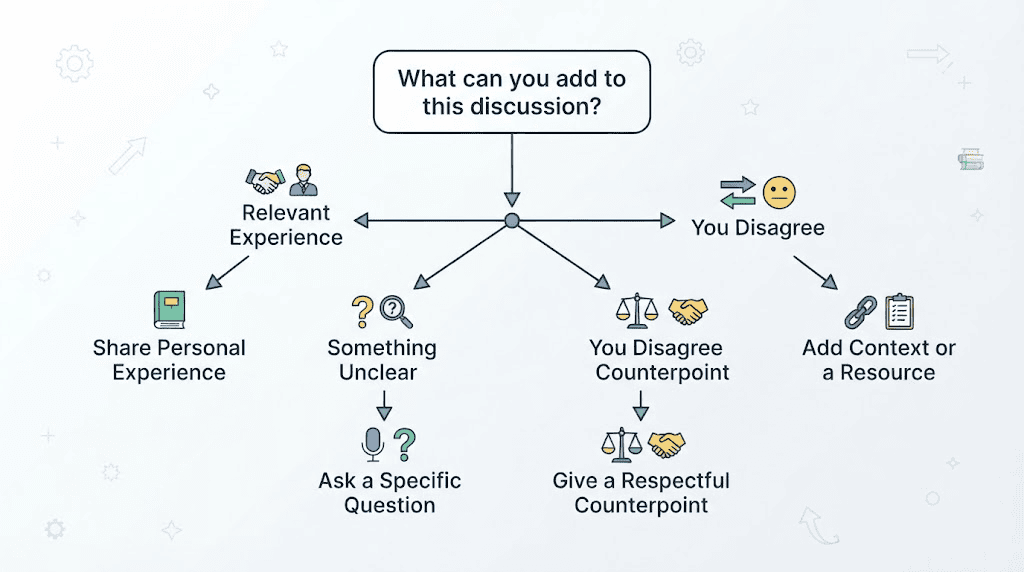
Not every comment should look the same. Use this quick decision guide:
- If you have direct, relevant experience → share a personal experience comment (see examples 6–10)
- If something is genuinely unclear or incomplete → ask a specific clarifying question or point out the gap (examples 11–15, 21–25)
- If you disagree with part of the argument → offer a respectful counterpoint, not a flat rejection (examples 16–20)
- If you’re short on time but still want to contribute → a short, specific reaction beats a long generic one (examples 31–35)
- If you have subject-matter authority → add context that only someone with that background would know (examples 36–40)
- If you followed a tutorial or how-to → report what worked, what didn’t, and any gaps (examples 46–50)
Pros and Cons of Investing Time in Blog Commenting
Pros
- Builds genuine visibility and relationships within an industry or niche over time
- Can drive real, qualified referral traffic from engaged readers
- Costs nothing beyond time, unlike paid promotion or outreach campaigns
- Improves your own thinking, since writing a specific, well-reasoned comment forces clarity
Cons
- Provides little to no direct SEO ranking benefit due to widespread nofollow/ugc tagging
- Time-intensive if done well — a genuinely valuable comment takes real thought, not five seconds
- Results (relationships, traffic, recognition) build slowly and aren’t guaranteed
- Comments can be removed or held in moderation regardless of quality, especially on tightly moderated blogs
Final Verdict
Blog commenting has changed. It’s no longer a link-building shortcut, and treating it as one wastes time and produces the exact low-value comments that get filtered out. What it still is — reliably — is a legitimate way to build visibility, credibility, and relationships in a niche, one genuinely useful comment at a time. The comments that work in 2026 share a consistent pattern: they’re specific to the post, they add something the post didn’t already say, and they respect the reader’s time.
If you are looking to further expand your outreach strategy and understand how community engagement fits into a broader digital presence, you can explore more insights on Pixwox.
Use the 50 examples above as a starting structure, not a script — the goal isn’t to copy the wording, it’s to internalize the habit of engaging with real substance instead of generic praise.
FAQs About Good Blog Comments
What makes a blog comment good?
A good blog comment is specific to the post, adds something new (an experience, a question, a correction, or a resource), and is written to help the author or other readers rather than primarily to promote a link.
Do blog comments still help SEO in 2026?
Not through direct link-building — the vast majority of comment links are tagged nofollow or rel=”ugc”, which Google treats as a hint not to pass ranking authority. Comments can support engagement signals and occasionally drive referral traffic, but they aren’t a reliable SEO ranking strategy.
Should I put a link in my blog comment?
Only when it’s genuinely relevant and adds value for other readers, and only after you’ve contributed something substantive. Comments that lead with a link and little else are commonly flagged as spam and removed.
How long should a blog comment be?
There’s no fixed length. Some of the most valuable comments are two or three sentences; length only matters if it corresponds to added value, not padding.
Is it okay to disagree with a blog post in the comments?
Yes, and thoughtful disagreement is often more valuable than agreement, as long as it’s framed respectfully and backed by a specific reason rather than a blanket dismissal.
What is a rel=”ugc” tag on a blog comment link?
It’s an attribute Google recommends site owners apply to links within user-generated content, such as blog comments and forum posts, to indicate the link wasn’t placed or endorsed by the site owner. It signals to search engines not to pass ranking authority through that link.
Why do some blog comments get held for moderation or removed?
Most active blogs use spam filters and manual moderation, especially for first-time commenters, to prevent irrelevant text, bot-generated content, or spammy links from appearing on the page. Genuinely relevant, well-written comments are far more likely to be approved quickly.
Can commenting on blogs actually grow my business or personal brand?
It can, but gradually and indirectly — through visibility with an engaged, relevant audience, referral traffic, and relationship-building — rather than through any direct SEO or ranking mechanism.