
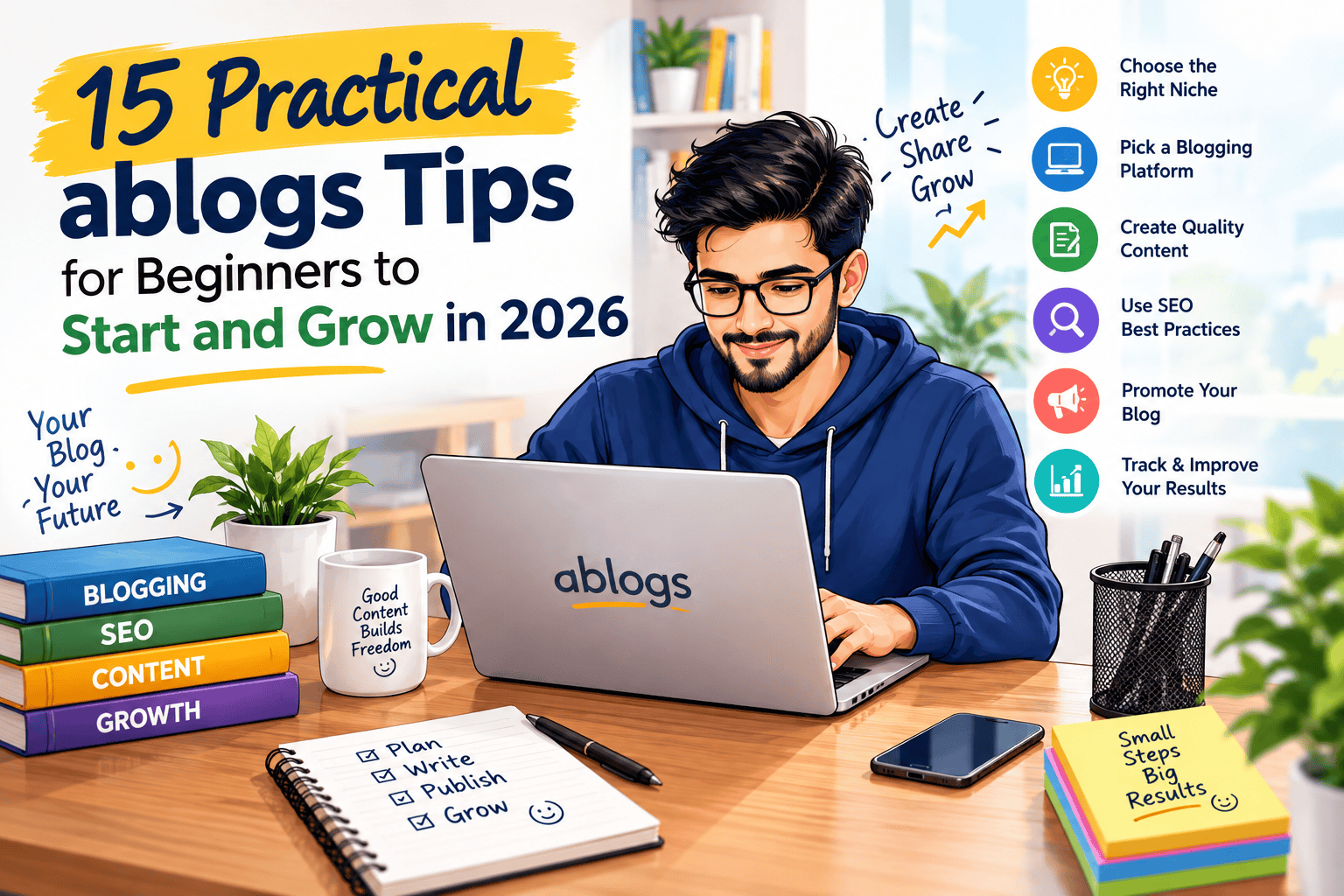
New to ablogs? Learn 15 practical tips to start ablogs, choose the right platform, write SEO-friendly posts, and grow your audience in 2026.
Starting a blog can be exciting, but turning a new website into a useful, discoverable, and sustainable publishing platform takes planning. Whether you want to share your knowledge, build a personal brand, promote a business, or eventually earn money online, the decisions you make at the beginning can have a major impact on your results.
For beginners, ablogs can provide a practical way to organize ideas, publish useful content, attract search traffic, and develop an audience over time. However, publishing random articles is rarely enough. Successful blogging requires a clear niche, useful content, basic SEO, consistent publishing, and a willingness to improve older articles.
The good news is that you don’t need to be an expert to begin. You can start with a simple website, learn the fundamentals gradually, and build your content strategy as your audience grows.
This guide explains 15 practical ablogs tips that beginners can use to create better content, improve search visibility, and build a blog that can grow throughout 2026 and beyond.
Quick Answer: How Can Beginners Start ablogs Successfully?
To start ablogs successfully, choose a focused niche, select a reliable blogging platform, buy a custom domain, understand your target audience, research keywords, match articles to search intent, and publish genuinely useful content consistently.
Don’t try to compete with established websites immediately. Start with specific topics and long-tail keywords that closely match what your audience wants to know. Optimize your titles, headings, URLs, images, internal links, and meta descriptions, then use analytics and Search Console data to improve your strategy.
Most importantly, treat blogging as a long-term project. Search visibility and audience growth usually take time, so focus on creating a useful content library instead of expecting immediate results.
Why ablogs Can Be Difficult for Beginners
Many new bloggers begin with enthusiasm but don’t have a clear publishing strategy. They write a few articles, wait for traffic, and become discouraged when visitors don’t arrive immediately.
Several common problems contribute to this:
- Choosing a niche that is too broad
- Targeting extremely competitive keywords
- Writing without understanding search intent
- Publishing inconsistent content
- Ignoring internal linking
- Using poorly optimized images
- Focusing entirely on search engines instead of readers
- Failing to update older content
- Expecting traffic and income too quickly
The solution is not necessarily to publish more. It is to build a repeatable process that improves your website one useful article at a time.
1. Choose a Focused Niche for Your ablogs
One of the first decisions you need to make is what your website will be about.
A broad topic can give you thousands of possible article ideas, but it also puts you against established websites with large audiences and strong backlink profiles. A focused niche makes it easier to understand your audience and create related content.
For example, instead of creating a website about “technology,” you could focus on:
- AI tools for beginners
- Smartphone tips
- Blogging tutorials
- Social media privacy
- Website optimization
- Beginner-friendly software guides
A useful niche should have three characteristics:
- You can create content about it consistently.
- People actively search for information about it.
- It offers opportunities for audience growth or monetization.
Don’t choose a niche solely because you think it will make money. If you cannot consistently produce useful information about the subject, maintaining the site will become difficult.
2. Choose the Right Platform for Your ablogs Website
Your blogging platform determines how much control you have over your website, design, plugins, monetization, and future growth.
Blogging Platform Comparison
| Platform | Best For | Control | Difficulty |
|---|---|---|---|
| WordPress.org | Serious blogs and businesses | High | Moderate |
| WordPress.com | Beginners | Medium | Easy |
| Wix | Visual websites | Medium | Easy |
| Squarespace | Design-focused websites | Medium | Easy |
| Medium | Writers wanting simplicity | Low | Very easy |
| Substack | Newsletter-focused publishing | Medium | Easy |
| Ghost | Publishing and memberships | High | Moderate |
For a website you intend to develop for several years, self-hosted WordPress gives you considerable control over themes, plugins, SEO settings, monetization, and website structure.
If you’re simply experimenting with writing, a hosted platform can be easier because you don’t have to manage as much technical infrastructure.
The important thing is to choose a platform that matches your actual goals rather than choosing based solely on popularity.
3. Get a Custom Domain and Reliable Hosting
A professional domain gives your ablogs website its own identity.
Instead of relying on a free subdomain, consider registering a short and memorable domain related to your brand or topic.
When selecting hosting, look for:
- Good uptime
- Fast server response
- SSL support
- Regular backups
- Easy WordPress installation
- Customer support
- Scalable hosting plans
Website performance matters because slow pages can create a poor user experience. Before spending heavily on premium hosting, however, make sure the plan provides what your current website actually needs.
You can also learn more about website optimization through Google’s official PageSpeed Insights, which can help you identify performance issues.
4. Define Your Target Reader
Before writing an article, decide exactly who you’re trying to help.
Imagine one specific reader sitting in front of you. What are they trying to accomplish?
Ask questions such as:
- What problem are they experiencing?
- What information are they looking for?
- Are they beginners or experienced users?
- What terminology do they understand?
- What would make them trust the information?
- What action should they take after reading?
For example, an article about starting a blog for complete beginners should not assume that the reader already understands hosting, domains, plugins, keywords, or search intent.
Writing for a specific reader naturally improves clarity.
5. Understand Search Intent Before Creating ablogs Content
Keywords tell you what people type into search engines, but search intent helps you understand why they search.
The four common categories are:
Informational Intent
The reader wants to learn something.
Examples:
- What is blogging?
- How does SEO work?
- How do I create a blog?
Navigational Intent
The reader wants to reach a particular website or resource.
Examples:
- WordPress login
- Google Search Console
- Medium
Commercial Investigation
The reader is researching options before making a decision.
Examples:
- Best blogging platforms
- WordPress vs Wix
- Best hosting for bloggers
Transactional Intent
The reader is ready to take an action.
Examples:
- Buy web hosting
- Start WordPress hosting
- Subscribe to a blogging service
Your article should match the intent behind the keyword. If someone searches for a comparison, give them a comparison. If they search for a tutorial, provide clear steps.
6. Research Long-Tail Keywords
New websites usually shouldn’t try to rank immediately for extremely broad terms.
Instead, build your ablogs content strategy around specific long-tail keywords.
For example:
Broad keyword:
- Blogging
More specific keywords:
- How to start a blog for beginners
- How to write a blog post
- Best blogging platform for beginners
- How to promote a new blog
- Blogging tips for beginners
Long-tail keywords may have lower search volume, but they can be more specific and easier to align with a reader’s needs.
Use keyword research to discover:
- Primary keywords
- Related keywords
- Question-based searches
- Long-tail variations
- Search intent
- Competing content
- Topic gaps
Don’t repeat the same phrase unnaturally. Use related terminology where it makes sense.
7. Create One Strong Cornerstone Article
A cornerstone article is a comprehensive resource covering an important topic in your niche.
For example, if your website focuses on blogging, a cornerstone article might cover:
How to Start a Blog: A Complete Beginner’s Guide
You can then publish supporting articles about:
- Blog keyword research
- Blog post formatting
- Internal linking
- Blog promotion
- Email marketing
- On-page SEO
- Content planning
Link the supporting articles to your cornerstone guide and link the cornerstone guide back to relevant supporting content.
This creates a connected website structure that helps both readers and search engines discover related information.
8. Optimize Every ablogs Post for Basic SEO
You don’t need complicated SEO techniques to begin.
Start with the fundamentals.
SEO Checklist
Before publishing, check that your article has:
- One clear H1
- A descriptive SEO title
- A useful meta description
- A clean URL
- The primary keyword used naturally
- Related terms throughout the article
- Useful H2 and H3 headings
- Internal links
- Relevant external references
- Descriptive image alt text
- Short, readable paragraphs
- Helpful lists or tables where appropriate
Your primary keyword should appear naturally in important areas, but avoid forcing it into every paragraph.
Google’s Search Essentials provides official guidance on creating content that can be discovered and understood by Google Search.
9. Publish Consistently
You don’t need to publish every day.
A realistic schedule is more valuable than an ambitious schedule you cannot maintain.
For example:
- 1 article every week
- 2 articles every month
- 1 comprehensive article every two weeks
Choose a schedule based on the amount of time you actually have.
Consistency also makes content planning easier. Instead of asking yourself what to write every morning, create a list of 20–30 potential topics and organize them into monthly publishing plans.
A small number of genuinely useful articles can be more valuable than a large collection of thin content.
10. Make Your ablogs Content Easy to Read
Online readers rarely read every word immediately. They usually scan headings, lists, bold phrases, images, and the first few paragraphs before deciding whether the article deserves their attention.
Improve readability with:
- Short paragraphs
- Clear headings
- Numbered steps
- Bullet points
- Tables
- Examples
- Screenshots
- Diagrams
- Helpful summaries
Avoid large blocks of text.
A strong article should make it easy for someone to find the exact answer they’re looking for while still providing enough detail for readers who want a complete explanation.
11. Add Relevant Images With Proper SEO
Images can make an article more useful and visually engaging, but they should support the content rather than simply fill space.
For this article, an appropriate image could use:
Image filename:ablogs-tips-for-beginners.jpg
Alt text:ablogs tips for beginners
Caption:Practical ablogs tips for beginners building a successful website in 2026.
You can also add screenshots, diagrams, charts, or original illustrations when they genuinely help explain a concept.
Keep image file sizes reasonable and use descriptive filenames and alt text.
Alt text should describe the image accurately. Don’t add keywords that have nothing to do with what the image shows.
12. Promote Every New ablogs Article
Publishing an article doesn’t guarantee that people will find it.
Promotion can help expose new content to potential readers.
Depending on your niche, consider:
- Email newsletters
- Facebook communities
- Reddit communities
- Relevant online forums
- Industry websites
- Blogger outreach
- Social media posts
Don’t spam communities with links. Participate genuinely and share an article when it directly answers a question or provides useful information.
You can also contact websites that publish related content and explain why your resource could be useful to their readers.
13. Build an Email List Early
Search traffic can fluctuate. Social platforms can change their algorithms. An email list gives you a direct communication channel with people who have chosen to hear from you.
You can encourage subscriptions by offering something useful, such as:
- A checklist
- A template
- A short guide
- A resource list
- A free newsletter
- A content upgrade
Don’t wait until your website receives thousands of visitors.
Even a small email list can become valuable if subscribers are genuinely interested in your subject.
14. Monitor Your ablogs Performance
You cannot improve what you don’t measure.
Set up Google Search Console and an analytics platform so you can understand how people discover and use your content.
Important metrics include:
Organic Traffic
Shows whether search visibility is increasing.
Search Queries
Shows the terms for which your pages appear.
Click-Through Rate
Helps you understand how often searchers click your result after seeing it.
Top Pages
Shows which articles attract the most visitors.
Conversions
Measures valuable actions such as email subscriptions, product purchases, or contact form submissions.
Don’t obsess over a single metric. Look for patterns over several weeks or months.
15. Update and Improve Older Content
Creating new articles is only part of maintaining a successful blog.
Older articles can often be improved by:
- Updating statistics
- Replacing outdated examples
- Adding new sections
- Improving introductions
- Adding internal links
- Improving images
- Fixing broken links
- Updating screenshots
- Improving titles and descriptions
- Answering new reader questions
Review your older content periodically and prioritize pages that already receive impressions or traffic but could provide a better answer.
This approach allows your existing content library to become more useful over time.
How to Build a Simple ablogs Content Strategy
You don’t need a complicated editorial calendar.
Start with three content levels:
Pillar Content
Create comprehensive guides around your most important topics.
Supporting Content
Publish smaller articles answering specific questions related to your pillar topics.
Fresh and Timely Content
Cover new developments, trends, updates, or frequently changing information when relevant to your niche.
For example, a blogging website might organize its content like this:
Pillar:
How to Start a Blog
Supporting articles:
- How to Choose a Blog Niche
- How to Find Blog Keywords
- How to Write Better Blog Posts
- Basic On-Page SEO for Bloggers
- How to Promote a New Blog
- How to Build an Email List
This structure gives you a logical content system rather than a collection of unrelated posts.
Internal Linking Strategy for ablogs
Internal links help readers discover additional information on your website.
For example, when discussing keyword research, link to your detailed [keyword research guide].
When discussing SEO, link to your [beginner’s SEO guide].
When discussing content planning, link to your [content strategy guide].
Use descriptive anchor text that tells readers what they will find after clicking.
Don’t add internal links simply to increase the number of links. Every link should have a useful purpose.
External Resources Worth Using
Reliable external resources can strengthen an article when they provide additional information or primary documentation.
For blogging and SEO, useful references include:
- Google’s Search Essentials for search optimization guidance
- Google Search Console for monitoring search performance
- Official documentation from the blogging platform you use
External links should be relevant to the statement being made. Avoid adding unrelated links simply because an SEO plugin recommends external links.
Pros and Cons of Starting a Blog in 2026
Pros
- Relatively low startup costs
- Opportunity to build an owned online asset
- Multiple potential monetization methods
- Can strengthen personal or business credibility
- Provides a platform for sharing expertise
- Content can continue attracting visitors after publication
Cons
- Competition is high
- Search traffic usually takes time to develop
- Content requires ongoing maintenance
- SEO changes can affect traffic
- Monetization is rarely immediate
- Consistent publishing requires discipline
Understanding these realities before you begin can help you create more realistic expectations.
How Long Does It Take for ablogs to Grow?
There is no fixed timeline.
A new website can receive traffic quickly from social media or existing audiences, while organic search growth may take considerably longer. Results depend on factors such as niche competition, content quality, website authority, backlinks, search intent, technical SEO, and publishing consistency.
Instead of setting a specific traffic number for a particular month, track progress through measurable improvements:
- More indexed pages
- More search impressions
- More ranking keywords
- Increasing organic clicks
- More returning visitors
- More email subscribers
- More conversions
These indicators provide a better picture of whether your content strategy is developing.
Final Thoughts on ablogs
Starting a blog in 2026 is still an accessible way to publish information, develop an audience, and build a long-term online presence. However, successful ablogs require more than simply writing articles and pressing Publish.
Start with a focused niche and a clear target reader. Choose a platform that fits your goals, research topics carefully, understand search intent, and create content that genuinely answers people’s questions.
Then build a sustainable publishing routine. Optimize your articles for basic SEO, connect related pages with internal links, promote your work through appropriate channels, collect email subscribers, and regularly improve older content.
Don’t measure your progress only by how quickly traffic increases. Building a useful content library takes time. The goal is to create a website that becomes more valuable with every useful article you publish.
Frequently Asked Questions About ablogs
What are ablogs?
The term ablogs can be used as a keyword or brand-style term related to blogging and blog publishing. In practical terms, the same fundamental principles apply: choose a topic, create useful content, publish consistently, optimize for search, and build an audience.
How do I start ablogs as a beginner?
Start by selecting a focused niche, choosing a blogging platform, registering a domain, setting up hosting, and creating a simple website. Then research topics your target readers are searching for and begin publishing useful articles.
Is WordPress good for ablogs?
Self-hosted WordPress is a flexible option for bloggers who want control over their website, design, plugins, SEO, and monetization. Beginners who want a simpler setup can also consider hosted blogging platforms.
How often should I publish ablogs content?
There is no universal publishing frequency. One high-quality article every one or two weeks can be a practical starting point for a beginner. The important factor is maintaining a schedule you can realistically continue.
Can beginners make money from blogging?
Yes, blogging can be monetized through advertising, affiliate marketing, sponsorships, digital products, services, memberships, and other methods. However, income varies significantly and usually depends on traffic, audience trust, niche, content quality, and monetization strategy.
What should my first ablogs article be about?
Your first article should solve a specific problem for your target reader. A focused beginner guide or long-tail topic is often easier to develop than an extremely broad article.
Does SEO matter for beginners?
Yes. You don’t need advanced technical SEO knowledge to begin. Start with keyword research, search intent, descriptive titles, logical headings, internal links, useful content, optimized images, and a clean website structure.
How can I get traffic to a new blog?
Use a combination of organic search, social media, communities, email marketing, networking, and relevant outreach. Focus on creating content that people have a reason to discover and share.
Should I update old articles?
Yes. Review older articles periodically and update information, improve explanations, add relevant internal links, replace outdated images, and address questions that readers now have.
Is blogging still worth starting in 2026?
Blogging remains a viable publishing and audience-building model, but competition means beginners need a clear niche, useful content, realistic expectations, and a consistent strategy. Long-term results depend on the quality and usefulness of the website rather than simply the number of articles published.