
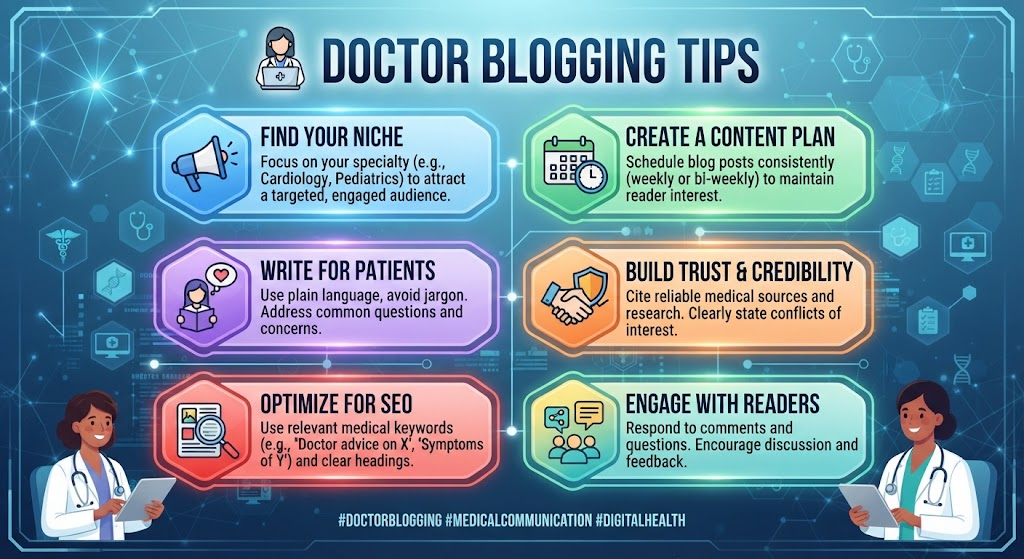
Discover 15 practical doctor blogging tips to grow your medical practice, build patient trust, and stay compliant while writing content that ranks.
Introduction
Doctors are busy — which is exactly why most physician blogs get started with good intentions and then quietly stop after three posts. Between patient care, admin work, and everything else on a practice’s plate, blogging often feels like the first thing to get cut. But a blog is still one of the most effective, low-cost ways for a medical practice to build trust, attract new patients, and show up when someone searches for answers to a health question. That’s where solid doctor blogging tips make the real difference.
This guide covers 15 practical doctor blogging tips built specifically for physicians, practice managers, and healthcare marketers — covering everything from choosing topics patients actually search for, to writing in a way that builds trust, to staying compliant with patient privacy rules. None of this requires a marketing degree. It just requires a clear, repeatable approach.
Why Doctor Blogging Tips Matter More Than Generic Marketing Advice
Medical marketing isn’t like marketing a retail store or a SaaS product. Patients researching symptoms, treatments, or providers are often anxious, comparing options, and looking for someone they can trust with something personal. That means the usual playbook of catchy headlines and aggressive calls-to-action doesn’t translate well to healthcare content.
Generic blogging advice also rarely accounts for patient privacy regulations, medical accuracy requirements, or the level of trust a healthcare audience expects before choosing a provider. This is why doctor blogging tips built specifically for medical practices — not repurposed from unrelated industries — tend to perform far better and carry far less risk.
15 Doctor Blogging Tips to Grow Your Medical Practice
1. Write About What Patients Actually Search For
Before writing a single post, think about the questions patients ask in the exam room, on the phone, or in intake forms. Topics like “what to expect before a colonoscopy” or “how long does recovery take after knee replacement” consistently perform better than broad, vague topics like “the importance of preventive care.”
A simple way to build a topic list: ask front-desk staff and nurses what patients ask most often during a typical week. Those recurring, specific questions are usually a better source of blog topics than anything a marketing brainstorm session would come up with.
2. Answer One Clear Question Per Post
Resist the urge to cover everything in a single article. A focused post that fully answers “Is it safe to exercise with high blood pressure?” is more useful — and ranks better — than a sprawling post trying to cover ten unrelated topics at once.
3. Write in Plain Language, Not Clinical Jargon
Patients aren’t reading your blog to feel confused. Replace clinical terminology with plain-language explanations wherever possible, and define any medical term you do need to use. This is one of the simplest doctor blogging tips, yet it’s the one most medical blogs get wrong.
| Instead of | Use |
|---|---|
| “Myocardial infarction” | “Heart attack” |
| “Hypertension” | “High blood pressure” |
| “Contraindicated” | “Not recommended for” |
4. Lead With Empathy, Not Just Facts
Before diving into clinical information, acknowledge the concern behind the question. A post about chronic pain management reads very differently — and builds far more trust — when it opens by recognizing how frustrating ongoing pain can be, rather than jumping straight into treatment options.
5. Keep Every Medical Claim Accurate and Sourced
Accuracy isn’t optional in healthcare content. Every claim about a condition, treatment, or statistic should be something you, as a licensed clinician (or your reviewing physician), can stand behind. When referencing outside data, link to a reputable, current source rather than repeating a number you’re not fully sure of.
6. Have a Licensed Clinician Review Every Post
Even if a practice manager or marketing team writes the first draft, a licensed physician should review medical content before it publishes. This single step protects both patients and the practice, and it’s one of the most important doctor blogging tips for maintaining credibility.
7. Respect Patient Privacy in Every Example
Never describe a real patient case in enough detail that someone could identify them, even indirectly. Use fully anonymized, composite, or hypothetical examples instead. The HHS guidance on HIPAA and patient privacy is worth reviewing before publishing any content that references patient scenarios, and the AMA’s guidance on professionalism in online communication outlines the broader ethical considerations physicians should weigh before posting.
8. Structure Posts for Skimming
Healthcare readers are often researching while anxious or short on time. Use:
- Short paragraphs (2–4 sentences)
- Clear H2 and H3 subheadings
- Bullet points for symptoms, steps, or options
- Bold text sparingly, for genuinely important warnings or takeaways
9. Include a Clear Next Step
Every post should end with a clear, low-pressure next step — scheduling a consultation, calling the office, or reading a related post. Avoid pushy sales language; healthcare readers respond better to a calm, helpful invitation than an aggressive call-to-action.
For example, closing a post about persistent migraines with “If these symptoms sound familiar, our team is happy to talk through your options” reads very differently than “Book now before it’s too late” — and it fits the tone patients expect from a healthcare provider.
10. Apply Basic On-Page SEO
Medical practices compete for visibility just like any other business. Cover the fundamentals on every post:
| SEO Element | What to Do |
|---|---|
| Title tag | Include your target phrase naturally near the start |
| Meta description | 150–160 characters, clear and specific |
| Headings | Target keyword in at least one H2 |
| URL slug | Short and descriptive |
| Images | Descriptive alt text, no patient-identifying content |
| Internal links | Link to related posts and relevant service pages |
11. Feature Your Doctor’s Real Credentials
Patients want to know who is behind the advice they’re reading. Include the writing or reviewing physician’s name, credentials, and a short bio at the end of each post. This is a direct application of E-E-A-T (Experience, Expertise, Authoritativeness, Trustworthiness), and it’s especially important for health-related content, where search engines and readers alike weigh credibility heavily.
12. Update Older Posts as Guidelines Change
Medical guidance evolves. A post about vaccination schedules, screening age recommendations, or treatment protocols needs to be revisited periodically to confirm it still reflects current standards. Outdated medical content is one of the fastest ways to damage patient trust.
13. Interlink Related Topics
If you’ve written about diabetes management, link it to related posts on diet, exercise, or medication adherence. This keeps readers engaged longer and helps search engines understand how your content connects, which is one of the more overlooked doctor blogging tips healthcare marketers skip.
14. Promote Posts Beyond the Blog
A well-written post that nobody sees doesn’t help your practice. Share new posts through your practice’s email newsletter, patient portal announcements, and social channels where appropriate — always keeping patient privacy and platform-specific health advertising rules in mind.
15. Track What Patients Actually Read
Use free tools like Google Search Console and Google Analytics to see which topics bring the most visits and which posts patients spend the most time reading. This tells you what to write more of, rather than guessing at future topics.
Adapting Doctor Blogging Tips by Specialty
Not every specialty needs the same content approach. A few examples of how these principles shift depending on practice type:
- Primary care: Focus on prevention, seasonal illness, and general wellness questions patients ask at annual visits.
- Dermatology: Visual, before-and-after style content (with proper patient consent) performs well, alongside plain-language explanations of common skin conditions.
- Orthopedics: Recovery timelines, what to expect after surgery, and physical therapy guidance tend to be the most-searched topics.
- Mental health practices: Tone matters even more here — content should be especially careful, non-stigmatizing, and clear about when to seek immediate help.
The underlying doctor blogging tips stay the same across specialties — plain language, accuracy, and patient privacy — but the specific topics and tone should reflect what patients in that specialty are actually researching.
Tools That Support Consistent Medical Blogging
A small, consistent toolkit makes it easier to maintain a medical blog without adding a heavy workload:
- A shared content calendar: Even a simple spreadsheet helps track topics, writers, and review status.
- A clinical review checklist: A short, repeatable checklist (accuracy, privacy, tone, sourcing) speeds up the physician review step.
- Free analytics tools: Google Search Console and Analytics show which topics are actually resonating with patients.
- A style guide: A short internal document covering plain-language preferences and approved terminology keeps multiple writers consistent over time.
None of these require a large budget — they just require setting them up once and reusing them for every post.
Common Mistakes in Medical Blogging (and How to Avoid Them)
| Mistake | Why It’s a Problem | Better Approach |
|---|---|---|
| Using real patient details | Risks a privacy violation | Use anonymized or composite examples only |
| Writing overly clinical content | Confuses and disengages readers | Translate jargon into plain language |
| Skipping physician review | Risks inaccurate or outdated claims | Require clinical review before publishing |
| Ignoring SEO basics | Content never gets found | Apply on-page SEO consistently |
| Publishing once and forgetting | Guidelines change; content goes stale | Review and update posts periodically |
How Doctor Blogging Tips Support the Full Patient Journey
A blog isn’t just for attracting new patients — it supports the entire relationship:
- Before a visit: Helps patients understand symptoms, conditions, or what to expect from a procedure.
- During decision-making: Builds trust in your expertise before a patient ever books an appointment.
- After a visit: Reinforces guidance on recovery, medication, or lifestyle changes patients may forget to ask about in person.
Thinking of your blog as part of ongoing patient communication — not just a marketing channel — changes how you choose topics and makes the content genuinely more useful.
Conclusion
A medical practice blog doesn’t need a huge content team or a big budget to be effective — it needs consistency, accuracy, and a genuine focus on the questions patients are already asking. These 15 doctor blogging tips cover the full picture: writing in plain language, protecting patient privacy, keeping content medically accurate, and applying the SEO basics that help the right patients actually find your practice. Start with two or three topics your patients ask about most often, have a licensed clinician review the content, and build from there — that’s how a medical blog earns trust one post at a time.
FAQs
1. What are the most important doctor blogging tips for a small practice just getting started?
Start with plain-language answers to the questions your patients already ask most often, have a licensed clinician review every post, and publish consistently rather than in bursts.
2. Is it safe to use real patient stories in a medical blog?
Only if fully anonymized or written as composite, hypothetical examples. Real, identifiable patient details should never appear in blog content — this is one of the most important doctor blogging tips for staying compliant with patient privacy expectations.
3. Who should write medical blog content — the doctor or a marketing team?
Either can write the first draft, but a licensed clinician should always review medical content before publishing to confirm accuracy and appropriateness.
4. How often should a medical practice update its blog?
Publishing consistently (even a post or two per month) matters more than volume, and older posts covering guidelines or treatment recommendations should be reviewed periodically to confirm they’re still accurate.
5. Do doctor blogging tips apply to specialists as well as general practitioners?
Yes. The same principles — clear language, patient privacy, accuracy, and search-friendly structure — apply whether the practice is primary care, dermatology, cardiology, or any other specialty.
6. How do I know if a blog topic is worth writing about?
If it’s a question patients already ask during appointments, on the phone, or through intake forms, it’s almost always worth covering — real patient questions are the most reliable source of topic ideas.
7. Can a medical blog actually bring in new patients?
Yes, when it consistently answers real patient questions and applies basic SEO, a blog can help a practice show up when potential patients are researching symptoms, treatments, or providers online.