

Cause questions social media marketing strategy can help you build an authentic campaign. Learn what to ask about purpose, audience, platforms, content, budget, and measurement.
A well-planned cause questions social media marketing strategy helps teams connect their purpose with the right audience, platforms, content, and measurable outcomes.
Cause questions social media marketing strategy planning ka essential starting point hain for brands and nonprofits that want to build authentic, effective campaigns. Before posting content, you need to understand why the cause matters, who you want to reach, which platforms fit your audience, and how success will be measured.
Asking the right cause questions before you build a social media marketing strategy is what separates campaigns that feel genuine and drive real support from ones that read as performative or forgettable. This guide walks through every question you need to answer — from purpose and audience to platform choice, partnerships, budget, and measurement — so your cause marketing on social media is grounded in evidence rather than guesswork.
What Is Cause Marketing on Social Media?
Cause marketing is when a brand, creator, or organization aligns its content and campaigns with a social or environmental issue — not as a one-off donation announcement, but as an ongoing part of how it shows up online. On social media, this can look like:
- A skincare brand running a recurring series about sustainable packaging
- A local coffee shop posting weekly updates about a scholarship fund it supports
- A nonprofit using Instagram Reels to explain the real-world impact of donations
- A tech company dedicating a content pillar to digital literacy for seniors
Done well, cause marketing builds trust and loyalty. Done poorly — without clear intent — it can look like “cause-washing,” where a brand slaps a hashtag on a post without any real commitment behind it. Audiences notice the difference, which is exactly why the questioning phase matters so much.
These answers give your cause questions social media marketing strategy a clear audience focus instead of relying on assumptions.
Why Asking the Right Questions Matters Before You Build a Strategy
Most social media marketing strategy failures don’t stem from a lack of creativity. They happen because nobody stopped to ask basic cause questions before diving into content calendars. According to HubSpot’s 2026 research, brands actively use five or more marketing channels, and a growing share say moving from broad platforms to niche communities has been their most effective diversification strategy, which means a scattered, unquestioned approach to cause content gets diluted fast across so many channels.
Answering the right questions upfront gives you:
- Clarity of purpose — so every post ties back to a reason, not a trend
- Audience alignment — so you’re not shouting into a channel your supporters don’t use
- Message consistency — so your cause narrative doesn’t shift every quarter
- Measurable outcomes — so leadership can see what the strategy actually achieved
- Protection from backlash — because vague or opportunistic cause content is where reputational risk lives
Cause Questions Social Media Marketing Strategy: Core Questions to Ask
Break the questioning process into six categories. Answer each honestly — as a team, not just as a marketer working alone — before a single post goes on the calendar.
1. Purpose and Authenticity Questions
- Why does this cause matter to our organization specifically, beyond good PR?
- Can we point to actual internal action (funding, policy, volunteering, sourcing changes) that backs up what we’ll say publicly?
- What happens if we’re asked to prove our commitment — do we have receipts?
- Is this cause connected to our industry, community, or customer base believably?
- Would we still support this cause if it never generated a single like or share?
If you can’t answer the last question with a confident “yes,” pause before building anything further. Authenticity questions are the foundation every other section depends on.
2. Audience Questions
- Who specifically do we want to reach: existing customers, new supporters, donors, volunteers, or policymakers?
- What does this audience already believe about the cause, and where are the gaps in their understanding?
- Which platforms does our specific audience actually use daily, versus which platforms we simply assume they use?
- What tone resonates with them — informative, emotional, urgent, hopeful, humorous?
- Are there sub-audiences (Gen Z donors vs. long-time supporters vs. corporate partners) who need different messaging?
This is also where real usage data should override assumptions. <cite index=”9-1,9-2″>According to a Pew Research Center survey of over 5,000 U.S. adults, YouTube and Facebook remain the most widely used online platforms, with 84% of adults using YouTube and 71% using Facebook, while half of adults use Instagram</cite>. If your cause campaign is aimed at a broad adult audience, ignoring the platforms with the widest reach in favor of a trendier app can quietly undercut your strategy before it starts.
3. Platform and Channel Questions
- Which platform format best fits the type of storytelling our cause needs — short video, long-form community posts, live discussion, or visual proof of impact?
- Do we need a dedicated cause-specific account, or does this live inside our main brand channel?
- How much organic reach can we realistically expect, and does paid promotion need to be part of the plan?
- Which platform’s community norms match how we want to talk about this cause (e.g., LinkedIn for policy angles, Instagram/TikTok for emotional storytelling, YouTube for depth)?
4. Content and Storytelling Questions
- What’s the core narrative arc — the problem, the action we’re taking, and the outcome we want?
- Whose voices should carry the story: employees, beneficiaries, experts, leadership, or the community itself?
- How do we show impact instead of just claiming it (data, before/after, testimonials, behind-the-scenes)?
- How often can we realistically produce quality cause content without it becoming stale or repetitive?
- What formats — Reels, carousels, live Q&As, long captions, user-generated content — best carry this specific message?
5. Partnership and Credibility Questions
- Should we partner with an established nonprofit, advocacy group, or expert voice to add legitimacy?
- Who verifies the facts, statistics, or claims we plan to publish about the cause?
- Are there existing community leaders or micro-influencers already trusted in this space we should collaborate with instead of competing with?
- What’s our plan if a partner organization faces controversy — do we have an exit or response plan?
6. Measurement and Budget Questions
- What does success look like: awareness, donations, volunteer sign-ups, petition signatures, sales tied to a giving program, or something else entirely?
- What’s the realistic budget for content production, paid boosting, and any partnership fees?
- How will we track attribution — UTM links, donation platform integration, promo codes, or branded hashtags?
- What’s our reporting cadence, and who reviews the results?
- At what point do we decide a cause campaign isn’t working and needs to pivot?

Matching Cause Content to the Right Platform
Once you’ve answered the audience and platform questions above, use this comparison to sanity-check your channel choices before committing resources.
| Platform | Best For | Typical Content Format | Watch-Out |
|---|---|---|---|
| Visual storytelling, community building | Reels, carousels, Stories | Requires consistent visual quality | |
| TikTok | Reaching younger supporters, emotional/urgent causes | Short-form video, trends | Fast content cycle, needs frequent posting |
| Broad-reach awareness, older demographics, fundraising tools | Long posts, live video, fundraisers | Organic reach is limited without ads | |
| Corporate social responsibility, policy-driven causes | Articles, employee spotlights | Less effective for emotional appeals | |
| YouTube | In-depth impact stories, documentaries | Long-form video, mini-docs | Higher production time and cost |
| X (Twitter) | Real-time advocacy, joining public conversation | Threads, quick updates | Fast-moving; requires active moderation |
Use this table alongside HubSpot’s step-by-step framework — <cite index=”3-2″>the ten-step process walks through everything from goal-setting to measurement, and most marketing teams can work through the full framework in two to four weeks</cite> — as a practical way to convert your answered cause questions into an actual working document.
A Practical Example: How Cause Questions Shape Real Campaigns
Imagine a mid-sized outdoor apparel brand wants to support local watershed conservation. Instead of jumping straight to content, the team answers the cause questions first:
- Purpose: They already source materials with reduced water usage — so the cause connects to something real.
- Audience: Their core customers are hikers and campers aged 25–45, active mainly on Instagram and YouTube.
- Platform: They choose Instagram for weekly visual updates and YouTube for a quarterly mini-documentary.
- Content: They decide the story should be told by local conservationists, not brand executives.
- Partnership: They team up with a regional watershed nonprofit for credibility and shared reach.
- Measurement: Success is defined as newsletter sign-ups and dollars raised for the nonprofit — not just likes.
Because the questions were answered before content production started, every post has a clear job to do. That’s the difference the cause questions make in a social media marketing strategy — direction instead of improvisation.
Common Mistakes When Skipping the Cause Questions Stage
- Jumping straight to a content calendar without agreeing on purpose, so posts feel disconnected from each other
- Choosing platforms based on internal preference rather than where the target audience actually spends time
- Overpromising impact without a way to verify or report on it later
- Treating cause content as a single campaign instead of an ongoing commitment, which reads as opportunistic
- Ignoring budget questions until after content is planned, leading to half-finished campaigns
- Failing to define what “success” means, so the campaign can never be evaluated or improved
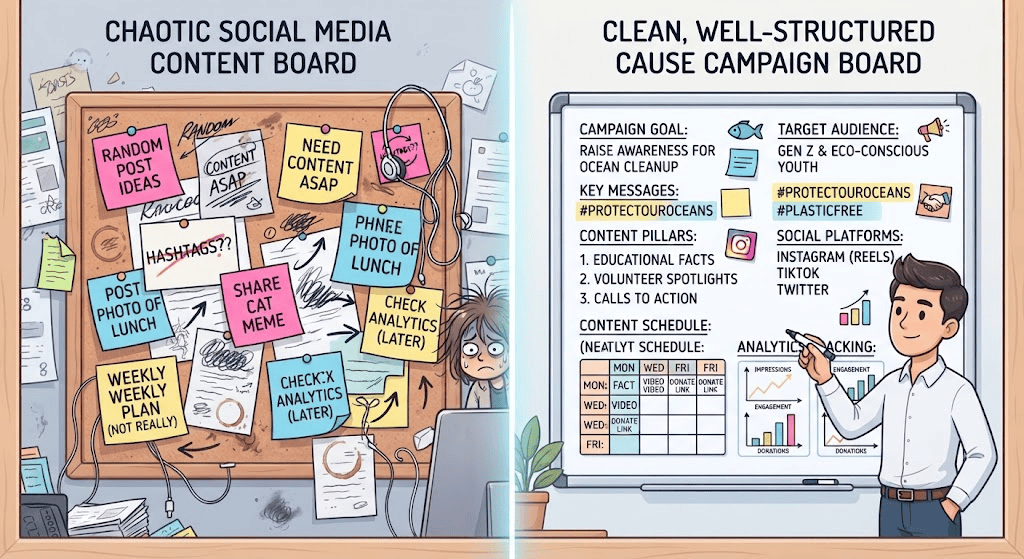
Cause Questions Social Media Marketing Strategy: A Simple Framework
Use the answers from each category to turn your cause questions social media marketing strategy into a practical plan your team can follow.
- Cause Statement — one or two sentences on what you support and why, in plain language
- Audience Summary — who you’re speaking to and where they spend time online
- Platform Plan — primary and secondary channels, with a reason for each
- Content Pillars — three to five recurring themes your cause content will rotate through
- Partnership Details — any nonprofit, expert, or community collaborator involved
- Budget Breakdown — production, paid promotion, and partnership costs
- Success Metrics — the specific numbers you’ll track and how often you’ll report on them
- Review Trigger — the point at which you’ll revisit or retire the campaign
This one-page framework becomes the reference document every piece of content gets checked against, keeping the strategy consistent even as different team members create posts over time.
Frequently Asked Questions
How is cause marketing different from a regular social media marketing strategy?
A standard strategy is usually built around product awareness, sales, or engagement. Cause marketing layers in a social or environmental issue as a genuine part of the brand’s identity, which means it needs extra scrutiny around authenticity, partnership credibility, and long-term commitment — not just reach and engagement numbers.
How many cause questions should a small business or nonprofit answer before starting?
At minimum, work through the six categories in this guide — purpose, audience, platform, content, partnership, and measurement. Skipping any one of them is usually where campaigns lose direction later.
Should every social media post mention the cause?
No. Overloading every post with cause messaging can feel forced. Most effective cause campaigns dedicate a defined percentage of the content calendar (commonly 15–25%) to cause-related posts, keeping the rest focused on regular brand content.
What’s the biggest red flag that a cause campaign isn’t ready to launch?
If your team can’t clearly answer the authenticity questions — why this cause, what you’re actually doing about it, and how you’d prove it — the campaign isn’t ready, regardless of how polished the content looks.
How often should a cause-based social media strategy be reviewed?
Quarterly reviews work well for most organizations, aligning with the “review trigger” step in the framework above. This gives enough time to gather meaningful data without letting an underperforming or outdated campaign run too long unchecked.
Conclusion
When these questions are answered first, your cause questions social media marketing strategy becomes easier to execute, measure, and improve.
A strong social media marketing strategy built around a cause doesn’t start with a content calendar — it starts with honest questions. Working through purpose, audience, platform, content, partnership, and measurement questions before you post gives your cause marketing direction, protects your credibility, and makes results measurable instead of accidental. The brands and organizations that get this right aren’t necessarily the ones with the biggest budgets; they’re the ones who took the time to ask the right cause questions before building their social media marketing strategy in the first place.