
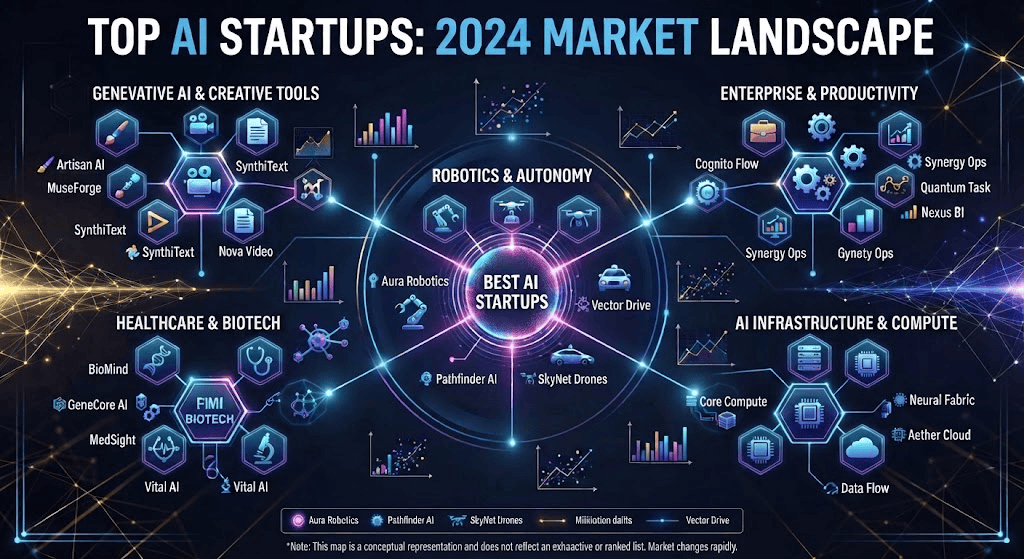
Discover the 15 best AI startups to watch in 2026 — from frontier labs to voice AI, robotics, and coding agents — with funding data, use cases, and a comparison table.
Artificial intelligence didn’t slow down in 2026 — it specialized. After two years of general-purpose chatbots dominating headlines, this year’s breakout companies are the ones solving specific, high-value problems: writing production code, controlling robots, generating lifelike voices, and running legal or medical workflows without a human doing every step.
This list of the best AI startups to watch in 2026 focuses on companies with real funding, real customers, and real product traction — not just hype. Whether you’re a founder scouting competitors, an investor tracking momentum, or a content creator curious about the tools reshaping video, voice, and image generation (relevant if you also work with tools like Instagram Reels downloaders or AI-assisted editing), this guide breaks down who’s winning and why.

Quick Answer
The best AI startups to watch in 2026 span five categories: frontier AI models (OpenAI, Anthropic, xAI, Mistral AI), AI coding agents (Cursor/Anysphere, Cognition AI), voice and creative AI (ElevenLabs, Black Forest Labs), vertical AI agents (Harvey, Hippocratic AI, Perplexity), and physical/robotics AI (Skild AI, Physical Intelligence). Databricks and Lovable round out the list as infrastructure and app-building leaders.
How We Selected These Best AI Startups
To keep this list credible, each company had to meet at least two of the following criteria as of 2026:
- A publicly reported funding round or valuation from a reputable source
- Verifiable enterprise or consumer adoption (named customers, user counts, or revenue figures)
- A clearly differentiated product rather than a thin wrapper around an existing model
- Momentum in the last 12 months (new funding, major partnership, or category leadership)
This is not an official ranking — companies are grouped by category and listed based on relevance and impact, not order of importance.
The 15 Best AI Startups to Watch in 2026
1. OpenAI
The company behind ChatGPT remains the most valuable AI startup in the world, reportedly reaching a $500 billion valuation in late 2025 following a $40 billion funding round earlier that year. OpenAI continues to push frontier model capability while expanding into enterprise tools, coding, and consumer products.
Why it matters: Sets the pace for what “state of the art” means in generative AI.
2. Anthropic
Anthropic focuses on building safe, steerable AI systems, with its Claude models used widely in coding, customer support, and enterprise research workflows. The company has become one of the fastest-growing AI labs by enterprise revenue.
Why it matters: A leading voice on AI safety standards that increasingly shape industry-wide practices.
3. xAI
Elon Musk’s AI company closed a reported $20 billion funding round in early 2026, pushing deeper into frontier model development and integrating AI across X (formerly Twitter) and Tesla products.
Why it matters: One of the best-funded challengers to established frontier labs.
4. Mistral AI
The French startup champions open-source, efficient AI models as an alternative to closed systems from U.S. labs. Its “Le Chat” assistant supports multiple languages and lets developers deploy models flexibly across environments.
Why it matters: A credible open-source counterweight in a market dominated by closed models.
5. Anysphere (Cursor)
Anysphere makes Cursor, an AI-powered coding environment that has become one of the fastest-growing developer tools of the decade, reportedly reaching a valuation in the tens of billions of dollars.
Why it matters: Coding is the AI agent category with the clearest product-market fit so far.
6. Cognition AI
Known for Devin, one of the first AI software engineers capable of independently completing coding tasks, Cognition strengthened its position by acquiring Windsurf, more than doubling its annual recurring revenue. Customers reportedly include major financial and technology firms.
Why it matters: A leading example of AI agents moving from “answering questions” to “executing work.”
7. ElevenLabs
What began as a text-to-speech tool has grown into a full voice AI platform covering dubbing, sound effects, music generation, and conversational voice agents, with enterprise clients spanning telecom, fintech, and media.
Why it matters: Voice AI is becoming core infrastructure for content creators, dubbing studios, and customer support teams alike.
8. Perplexity AI
Perplexity has positioned itself as an AI-native alternative to traditional search, combining real-time web results with conversational answers and citations.
Why it matters: Represents the shift toward AI-assisted (GEO-friendly) search behavior that this very article is optimized for.
9. Databricks
Databricks provides the data and AI infrastructure layer many other AI companies build on top of, with a valuation reported in the $130 billion range in 2026.
Why it matters: Infrastructure plays are often less visible but equally critical to the AI boom.
10. Lovable
This Swedish “vibe coding” startup lets non-technical users describe an app in plain language and get a working product, raising large rounds to become one of the clearest consumer-facing winners in AI app building.
Why it matters: Lowers the barrier to software creation for solo founders and small teams.
11. Hippocratic AI
Hippocratic AI builds patient-facing healthcare agents with a strict rule: they don’t diagnose or prescribe. Instead, they handle non-clinical tasks like medication onboarding and post-discharge follow-up, partnering with more than 50 health systems and payers across several countries.
Why it matters: Shows how vertical AI agents can operate safely inside heavily regulated industries.
12. Harvey
Harvey builds AI tools for legal teams, now used by a large share of major U.S. law firms for research, drafting, and due diligence, with a valuation that climbed sharply through 2026.
Why it matters: Legal is one of the clearest examples of AI agents automating high-value knowledge work.
13. Skild AI
Skild AI is building a single robotics foundation model — nicknamed the “Skild Brain” — designed to control different types of robots across different tasks, backed by a Series C that tripled its valuation in under seven months.
Why it matters: A general-purpose approach to robotics AI, rather than one model per robot type.
14. Physical Intelligence
Physical Intelligence develops a software-only robotics intelligence layer (model name π0) that can be applied across different hardware platforms, with funding rounds that have rapidly increased its valuation through 2026.
Why it matters: Physical AI and robotics have become one of 2026’s most heavily funded emerging categories.
15. Black Forest Labs
This German image-generation lab raised $300 million in 2026 at a $3.25 billion valuation and now powers image generation inside xAI’s Grok along with a range of other agent products.
Why it matters: High-quality image generation remains foundational for creative and social media tools, including AI-assisted photo and video editing workflows.
Comparison Table: 15 Best AI Startups to Watch in 2026

| Startup | Category | Known For | Notable 2026 Signal |
|---|---|---|---|
| OpenAI | Frontier Models | ChatGPT, GPT models | ~$500B valuation |
| Anthropic | Frontier Models | Claude, AI safety | Rapid enterprise revenue growth |
| xAI | Frontier Models | Grok | $20B funding round |
| Mistral AI | Open-Source AI | Le Chat, open models | Growing developer adoption |
| Anysphere (Cursor) | AI Coding | Cursor IDE | Tens-of-billions valuation |
| Cognition AI | AI Coding Agents | Devin, Windsurf | Acquired Windsurf, ARR surge |
| ElevenLabs | Voice AI | TTS, dubbing, agents | Enterprise clients across sectors |
| Perplexity AI | AI Search | Conversational search | Growing as a Google alternative |
| Databricks | AI Infrastructure | Data + AI platform | ~$134B valuation |
| Lovable | Vibe Coding | No-code app builder | Major consumer app-builder raise |
| Hippocratic AI | Healthcare AI Agents | Non-clinical patient agents | 50+ health system partners |
| Harvey | Legal AI | Legal research & drafting | Sharp valuation growth |
| Skild AI | Robotics AI | General robot foundation model | Valuation tripled in 7 months |
| Physical Intelligence | Robotics AI | π0 robotics intelligence layer | Rapid follow-on funding |
| Black Forest Labs | Image Generation AI | Powers Grok’s image gen | $3.25B valuation |
What’s Driving AI Startup Growth in 2026?
A few clear patterns explain why these companies are pulling ahead:
- Agents that act, not just answer. The market has shifted from AI that gives information to AI that completes tasks — writing code, processing claims, or managing customer conversations end to end.
- Vertical specialization. Instead of one model trying to do everything, startups in legal, healthcare, and robotics are winning by going deep into a single industry’s workflows.
- Infrastructure demand. As more companies build AI products, the underlying data, compute, and model-hosting layer (Databricks being a prime example) becomes just as valuable as the applications themselves.
- Creative and voice AI adoption. Tools like ElevenLabs and Black Forest Labs are increasingly embedded inside social media, video, and content workflows — the same space where creators use Reels downloaders, CapCut templates, and photo editing tools daily.
How to Evaluate an AI Startup (Practical Steps)

If you’re assessing any AI company — including ones not on this list — these steps help separate substance from hype:
- Check the funding source. Reports from Reuters, Bloomberg, or the company’s own press page carry more weight than aggregator blog posts.
- Look for named customers. Startups that can publicly name enterprise clients (banks, hospitals, law firms) usually have real deployments, not just pilots.
- Compare revenue growth, not just valuation. A high valuation with no disclosed revenue is a weaker signal than fast, verifiable ARR growth.
- Understand the moat. Ask whether the startup owns proprietary data, distribution, or a technical edge — or whether it’s a thin layer on top of someone else’s model.
- Watch the category, not just the company. A startup’s growth often says as much about its category (robotics, legal AI, coding agents) as it does about the company itself.
Frequently Asked Questions About Best AI startups
What makes a company one of the “best AI startups” in 2026?
A combination of verifiable funding, real customer adoption, and a genuinely differentiated product — not just marketing around a popular AI trend.
Which AI startups are best funded in 2026?
OpenAI, Anthropic, xAI, and Databricks are among the most heavily funded, with valuations reported in the hundreds of billions of dollars.
Are AI coding startups replacing software developers?
No. Tools like Cursor and Devin accelerate coding tasks and automate repetitive work, but they currently function as assistants and agents within developer workflows rather than full replacements for engineering judgment.
What is a “vibe coding” startup?
It refers to platforms like Lovable that let users describe an app in plain language and receive a working product, reducing the technical barrier to building software.
Is robotics really one of the biggest AI trends in 2026?
Yes. Physical AI and robotics foundation models, led by companies like Skild AI and Physical Intelligence, have become one of the most heavily funded emerging categories this year.
How does voice AI like ElevenLabs relate to social media tools?
Voice AI increasingly powers dubbing, captions, and auto-generated audio inside content creation workflows, complementing tools people already use for editing and publishing video content.
Can I invest directly in these AI startups?
Most are privately held and not available on public stock markets. Some investment access may exist through venture funds or employee share sales, but this varies by company and is not guaranteed.
Where can I find verified funding data on AI startups?
Reputable sources include the startups’ own press pages, Y Combinator’s company directory, and established financial news outlets like Reuters or Bloomberg.
Conclusion
The best AI startups of 2026 aren’t just building bigger models — they’re building agents and tools that do real work inside coding, healthcare, legal, robotics, and creative industries. From frontier labs like OpenAI and Anthropic to specialized players like Harvey and Skild AI, this year’s leaders share one thing in common: measurable traction, not just hype. As AI keeps moving from chat interfaces into action-taking agents, expect this list to keep shifting fast — so it’s worth revisiting a list like this every few months rather than treating any single snapshot as permanent.