
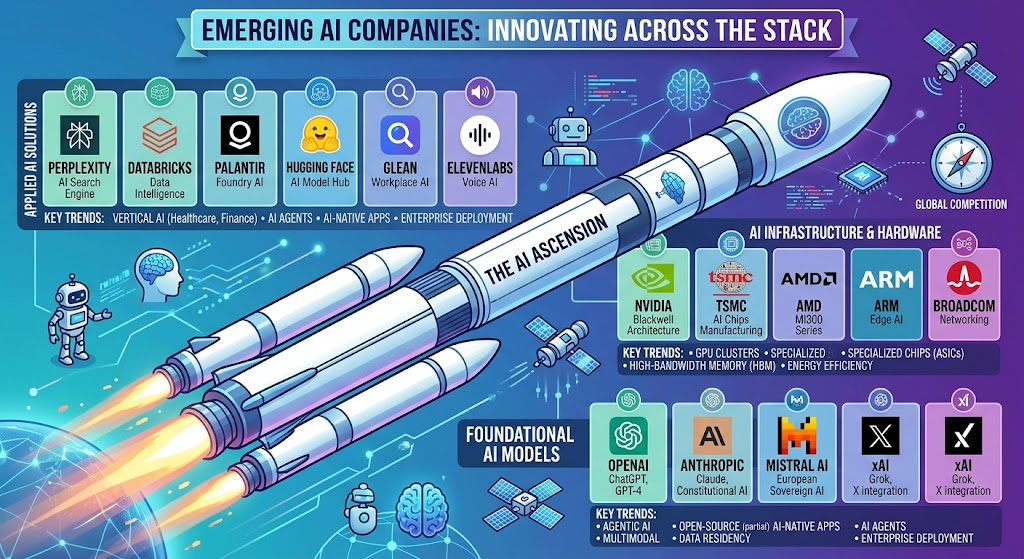
Discover 20 emerging AI companies to watch in 2026 — from coding agents and voice AI to robotics and healthcare — and why each one matters.
20 Emerging AI Companies to Watch in 2026
Artificial intelligence stopped being an experiment in 2026 and became infrastructure. Every week brings a new funding round, a new coding agent, or a new voice assistant that businesses are quietly folding into their daily workflows. With so much noise, it’s hard to tell which companies are genuinely shaping the next phase of AI and which are just riding the hype cycle.
This guide breaks down 20 emerging AI companies to watch in 2026, organized into six categories: foundation models, coding agents, enterprise AI agents, content and voice AI, healthcare AI, and robotics and security. For each company, you’ll find what it does, who it serves, and why it’s earning attention right now.

What Makes an AI Company “Emerging” in 2026?
An “emerging” AI company is typically one that is:
- Growing fast but not yet a household name — revenue, funding, or user adoption is accelerating quickly.
- Solving a specific, high-value problem rather than trying to be a general-purpose chatbot.
- Attracting serious institutional backing from venture capital firms, research labs, or enterprise customers.
- Shipping real products, not just research papers or demos.
This is different from “Big AI” — companies like the major foundation model labs and large cloud providers that already dominate headlines. The companies on this list sit just behind or alongside them, building the tools, agents, and infrastructure that make everyday AI adoption possible.
How We Chose These 20 Emerging AI Companies
Selection was based on a mix of factors that are commonly used to evaluate momentum in the AI industry:
- Recent funding rounds or valuation growth in 2025–2026
- Real enterprise or consumer adoption (not just pilot programs)
- Category leadership within a specific niche (coding, voice, legal, healthcare, robotics, security)
- Coverage and validation from independent industry research sources
Because funding figures and valuations change quickly in this sector, treat the specifics below as a snapshot rather than a permanent ranking, and check each company’s official site for the latest numbers.
Quick Overview: 20 Emerging AI Companies to Watch in 2026
| # | Company | Category | What It Does |
|---|---|---|---|
| 1 | Mistral AI | Foundation Models | Open-weight and enterprise language models |
| 2 | Cohere | Foundation Models | Secure, enterprise-grade language models |
| 3 | Perplexity AI | Foundation Models | AI-powered answer engine and search |
| 4 | Cursor (Anysphere) | Coding Agents | AI-native code editor and coding agent |
| 5 | Cognition AI | Coding Agents | Autonomous software engineering agent |
| 6 | Glean | Coding Agents / Enterprise Search | AI-powered enterprise knowledge search |
| 7 | Sierra | Enterprise AI Agents | Customer-facing conversational AI agents |
| 8 | Legora | Enterprise AI Agents | AI workflow automation for law firms |
| 9 | Harvey | Enterprise AI Agents | Legal research and analysis AI |
| 10 | Synthesia | Content & Voice AI | AI avatar-based video generation |
| 11 | AssemblyAI | Content & Voice AI | Speech-to-text and audio intelligence API |
| 12 | SoundHound AI | Content & Voice AI | Conversational voice AI platform |
| 13 | Ambience Healthcare | Healthcare AI | AI operating system for clinical documentation |
| 14 | Abridge | Healthcare AI | AI medical scribe for clinicians |
| 15 | Chai Discovery | Healthcare AI | AI-driven drug discovery |
| 16 | Physical Intelligence | Robotics & Physical AI | Foundation models for robots |
| 17 | Figure AI | Robotics & Physical AI | Humanoid robotics |
| 18 | Nuro | Robotics & Physical AI | Autonomous vehicle and delivery AI |
| 19 | Resistant AI | AI Security & Trust | AI-based fraud and document forgery detection |
| 20 | Oak Security | AI Security & Trust | Identity and access management for AI agents |
Foundation Models & Frontier AI Labs
These companies build the underlying language models that power everything from chatbots to coding assistants.
1. Mistral AI
Based in Paris, Mistral AI develops open-weight and commercial large language models and has positioned itself as a European alternative to US-based labs. Its Le Chat platform has expanded into a broader enterprise assistant with memory and integration features, appealing to businesses that want strong performance with more control over data residency and licensing terms.
2. Cohere
Cohere focuses squarely on enterprise use cases: retrieval-augmented generation, private deployment, and secure handling of proprietary data. Rather than chasing consumer chatbot market share, Cohere has built its reputation on helping regulated industries — finance, government, and healthcare — deploy language models without sending sensitive data to third parties.
3. Perplexity AI
Perplexity reimagines search as a conversation. Instead of a list of blue links, it returns direct, sourced answers pulled from the live web. It has become a genuine competitor to traditional search engines for research-style queries and is frequently cited as one of the fastest-growing AI-native consumer products.
AI Coding & Software Agents
AI-assisted coding shifted in 2026 from “autocomplete” to autonomous agents that can plan, write, and test code with minimal supervision.
4. Cursor (Anysphere)
Cursor is an AI-native code editor built around an agent that can generate full-stack applications — frontend, backend, and database — from natural-language instructions. It has grown rapidly among both professional developers and non-technical founders building MVPs.
5. Cognition AI
Cognition AI is known for building an autonomous software engineering agent capable of handling multi-step coding tasks with limited human oversight — writing code, running tests, and fixing its own bugs. It represents the shift from AI as a coding assistant to AI as a coding teammate.
6. Glean
Glean applies AI search and agent capabilities to internal company knowledge — documents, chats, tickets, and code — so employees (including engineers) can find answers instantly instead of digging through scattered tools. It has become a common entry point for enterprises adopting AI agents at scale.
Enterprise & Customer-Facing AI Agents
This category covers companies deploying AI agents that interact directly with customers or automate high-stakes professional work.
7. Sierra
Sierra builds customer-facing conversational AI agents designed to handle support, sales, and account management on behalf of brands — with an emphasis on staying on-brand and factually grounded rather than improvising.
8. Legora
Legora, based in Sweden, builds an AI platform for legal workflows — covering research, drafting, and document generation for law firms. Its rapid fundraising reflects a broader trend of legal teams trusting AI with more substantive analysis, not just basic document review.
9. Harvey
Harvey provides AI tools built specifically for law firms, focusing on high-value legal research and analysis. It has partnered with major firms and differentiates itself through deep customization for specific practice areas rather than a one-size-fits-all legal chatbot.
AI Video, Voice & Content Creation Tools
These companies are reshaping how video, audio, and voice content get produced — a category directly relevant to creators and social media teams.
10. Synthesia
Synthesia is a UK-based AI video generation platform that turns text scripts into videos featuring AI avatars and synthetic voiceovers in more than 100 languages. It’s used heavily for training videos, marketing content, and localized communications, cutting traditional filming costs and turnaround time.
11. AssemblyAI
AssemblyAI provides a speech-to-text API used by developers to build transcription and audio-intelligence features into their own products. It’s a backend player — most users never see the AssemblyAI name — but it powers voice features in a wide range of startups and apps.
12. SoundHound AI
SoundHound AI builds conversational voice and agent platforms used for customer service, sales, and in-vehicle voice assistants. Its technology turns spoken conversations into structured outcomes like bookings, orders, and support resolutions.
AI in Healthcare & Life Sciences

Healthcare remains one of the most active — and highest-stakes — areas for AI investment.
13. Ambience Healthcare
Ambience Healthcare builds an AI-powered operating system for clinical documentation, coding, and administrative workflows, aiming to reduce the paperwork burden that contributes heavily to clinician burnout. It’s used by several major hospital systems.
14. Abridge
Abridge focuses on AI medical scribing — listening to doctor-patient conversations (with consent) and generating structured clinical notes automatically, freeing clinicians to focus on the patient instead of the keyboard.
15. Chai Discovery
Chai Discovery applies AI models to drug development, aiming to speed up the identification and design of new therapeutic candidates. Its backers include major venture funds alongside AI labs themselves, reflecting how frontier AI companies are increasingly investing directly in applied science.
AI Robotics & Physical AI
“Physical AI” — models that control robots and vehicles rather than just generating text — is one of the fastest-moving frontiers in 2026.
16. Physical Intelligence
Physical Intelligence develops general-purpose foundation models for robots, aiming to give machines the kind of broad, adaptable intelligence that large language models brought to text — but applied to physical movement and manipulation.
17. Figure AI
Figure AI builds humanoid robots designed for real-world tasks in warehouses and manufacturing. The company has increasingly developed its own in-house AI models to control its robots, reducing reliance on external foundation model partners.
18. Nuro
Nuro builds an autonomy platform for self-driving vehicles and delivery robots, partnering with automotive and mobility companies to bring AI-powered autonomous systems to fleets and last-mile delivery.
AI Security, Identity & Trust
As AI agents get more autonomous, a new category of companies has emerged to keep them safe, accountable, and fraud-resistant.
19. Resistant AI
Resistant AI, based in the Czech Republic, builds document fraud detection and transaction monitoring systems for financial institutions, helping banks and fintechs catch AI-generated forgeries and manipulated documents before they cause losses.
20. Oak Security
Oak builds AI-native identity and access management, giving organizations a unified way to govern not just human logins but the growing number of autonomous AI agents that now need their own permissions and access controls.
How These Emerging AI Companies Are Shaping Content & Social Media Tools
Several of the categories above have a direct line to everyday content creation. AI avatar video platforms like Synthesia are changing how brands produce short-form video at scale, while voice AI companies are making it easier to generate captions, dubbing, and voiceovers automatically. For creators and marketers, this trend runs in parallel with the growing ecosystem of practical social tools — for example, if you’re managing Instagram content, a good Instagram Reels downloader remains a simple, everyday utility for saving and repurposing video content, even as AI tools handle more of the actual editing and generation work upstream.
If you want a shorter, curated list to start with, our earlier roundup of 12 best AI startups to watch in 2026 covers some of the same frontier labs and applied AI companies in more depth.
How to Track Emerging AI Companies Yourself
- Follow primary sources. Company blogs, official funding announcements, and press releases are more reliable than aggregator lists (including this one) for exact numbers.
- Watch funding databases. Sites that track venture funding rounds by sector (coding, healthcare, robotics, etc.) surface new entrants before they become mainstream news.
- Look at category leaders, not just totals. A company doesn’t need to be the biggest to be worth watching — leadership within a narrow niche (like legal AI or voice AI) is often a stronger signal.
- Check for real customers, not just demos. Public case studies and named enterprise clients are a better signal of traction than product demo videos alone.
- Reassess regularly. Valuations, funding rounds, and product direction in AI can shift within months, so treat any list — including this one — as a snapshot in time.
Comparison: Where Each Category Is Heading in 2026
| Category | 2025 Focus | 2026 Shift |
|---|---|---|
| Foundation Models | Bigger, more capable models | Efficiency, enterprise control, multilingual support |
| Coding Agents | AI autocomplete | Autonomous agents that plan and ship code |
| Enterprise Agents | Chatbot-style assistants | Agents that take real actions (bookings, refunds, filings) |
| Voice & Video AI | Text-to-speech novelty | Production-grade content and customer service use |
| Healthcare AI | Pilot programs | Hospital-system-wide clinical documentation tools |
| Robotics | Lab demonstrations | Deployed humanoid and delivery robots in real settings |
| AI Security | Model safety research | Governance and identity tools for autonomous agents |
FAQs
1. What does “emerging AI company” mean?
An emerging AI company is a business that is growing quickly in funding, adoption, or influence but hasn’t yet reached the scale or brand recognition of the largest players in the industry. It usually signals strong early traction rather than long-term market dominance.
2. Are these companies safe to use for business data?
Data-handling practices vary by company and by plan. Before using any AI tool with sensitive or private information, review its data retention, security certifications, and privacy policy directly on the company’s official website.
3. Which of these AI companies focus on coding?
Cursor (Anysphere), Cognition AI, and Glean are the three companies on this list most focused on software development, ranging from AI-assisted code editors to fully autonomous coding agents.
4. Are any of these companies working on AI for social media or content creation?
Yes — Synthesia (AI video with avatars), AssemblyAI (speech-to-text), and SoundHound AI (conversational voice AI) all build technology that content creators and marketing teams increasingly rely on for video, captions, and voice-based content.
5. How reliable are startup valuations mentioned in AI news?
Valuations reported in the media are often based on private funding rounds and can change quickly. Treat any valuation figure as a point-in-time estimate and confirm current numbers through the company’s own announcements when it matters for a decision.
6. Is bigger funding the same as being a better product?
Not necessarily. Funding reflects investor confidence and growth potential, but product quality, real customer adoption, and long-term execution matter just as much — sometimes more — than the size of a funding round.
7. How often should I check for new emerging AI companies?
Given how fast the sector moves, a quarterly check-in is reasonable for most readers. Investors or industry professionals may want to track funding announcements monthly.
8. Do any of these companies build robots or physical AI?
Yes — Physical Intelligence, Figure AI, and Nuro are all working on “physical AI,” applying AI models to robotics, humanoid machines, and autonomous vehicles rather than purely digital products.
Conclusion
The 20 emerging AI companies covered here represent six very different corners of the AI industry — from the foundation model labs training frontier systems, to the coding agents rewriting how software gets built, to the voice, healthcare, and robotics startups quietly automating real-world work. None of them are guaranteed to stay on top; that’s the nature of a fast-moving industry. But together, they offer a useful snapshot of where AI is actually being put to work in 2026 — not just talked about. Bookmark this list, revisit it periodically, and always verify the latest funding, product, and safety details directly from each company’s official channels before making any business or investment decision.