
Discover the 12 best AI startups to watch in 2026, from frontier models and AI agents to robotics, voice AI, enterprise software, and AI search.
Artificial intelligence is moving beyond chatbots and simple content-generation tools. In 2026, some of the most interesting AI startups are building foundation models, AI agents, enterprise platforms, voice systems, legal technology, robotics, and entirely new ways for people to interact with software.
The phrase AI startups covers a huge range of companies, from research labs developing frontier models to specialized businesses solving problems in healthcare, software development, customer service, media, and robotics.
This guide highlights 12 AI startups worth watching in 2026 based on their technology, product direction, market relevance, and potential to influence the next stage of artificial intelligence. The list is not a formal investment ranking, and “best” does not mean every company is suitable for every user or investor.
What Are AI Startups?

AI startups are technology companies that use artificial intelligence as a central part of their product, service, or business model.
Unlike traditional software companies that may simply add an AI feature to an existing application, AI-first startups generally build around technologies such as:
- Generative AI
- Large language models
- AI agents
- Machine learning
- Computer vision
- Voice AI
- Robotics
- Multimodal AI
- Enterprise AI
- AI infrastructure and data systems
The most important shift in 2026 is the move from AI that simply generates an answer toward AI that can understand context, use tools, complete multi-step tasks, and operate inside real business workflows.
For a broader explanation of how artificial intelligence is evolving, see TechCommand’s Ultimate Guide to Artificial Intelligence in 2026.
Best AI Startups to Watch in 2026
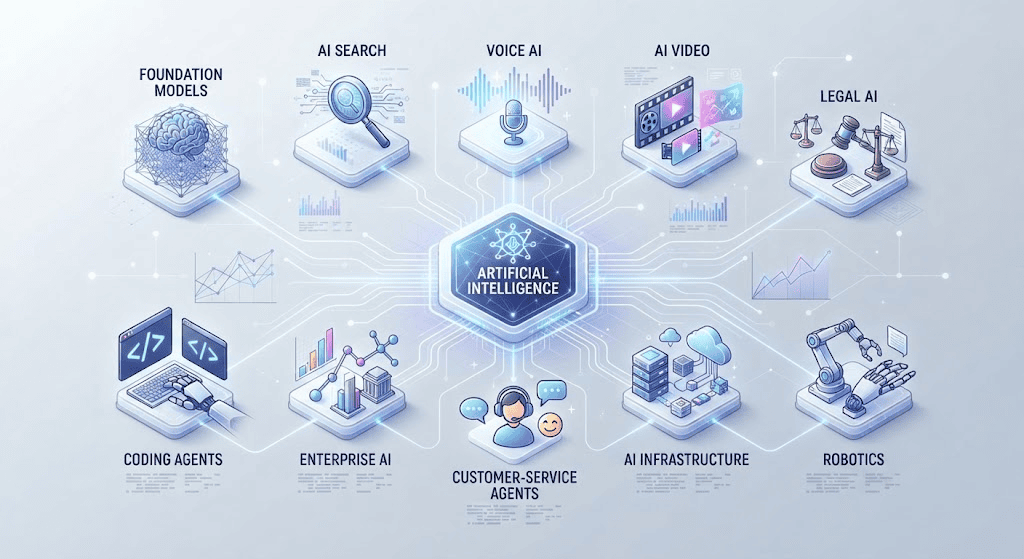
| Startup | Main Area | Why It Matters |
|---|---|---|
| Anthropic | Foundation models | Frontier AI, Claude and AI safety |
| Mistral AI | Open and enterprise AI | Open-weight models and European AI |
| Perplexity | AI search | Conversational search and research |
| ElevenLabs | Voice AI | Speech, dubbing and voice agents |
| Runway | Generative video | AI video and world models |
| Harvey | Legal AI | AI for legal and professional services |
| Anysphere | AI coding | Cursor and AI-assisted software development |
| Glean | Enterprise AI | Company knowledge, search and agents |
| Sierra | AI agents | Customer service and outcome-driven agents |
| Scale AI | AI infrastructure | Data, evaluation and AI deployment |
| Figure | AI robotics | Humanoid robots and physical AI |
| Sakana AI | AI research | New approaches to AI research and models |
1. Anthropic
Anthropic is one of the most important AI companies to watch because it combines frontier AI research with a strong focus on safety, reliability, and steerability.
The company develops Claude, its family of AI models and products. Anthropic describes itself as an AI safety and research company focused on building reliable, interpretable, and steerable AI systems.
In 2026, Anthropic has continued expanding Claude into coding, professional work, science, and enterprise applications. Its newsroom shows continued development across models, coding agents, safety research, and enterprise adoption.
Best known for:
- Claude
- AI coding
- Enterprise AI
- AI safety research
- Long-running AI agents
Why watch it: Anthropic is helping define what advanced AI assistants and agents could look like in professional environments.
Potential limitation: Its products are primarily designed around advanced AI use cases, so casual users may not need the full capabilities.
2. Mistral AI
Mistral AI is one of Europe’s most significant AI startups. Founded in 2023, the company has positioned itself around frontier AI, open models, developer tools, and enterprise deployments.
Its current model portfolio includes general-purpose, multimodal, coding, OCR, speech, and agentic models. Mistral also provides tools for developers and organizations to customize and deploy AI systems.
One of Mistral’s major differentiators is its emphasis on open-weight models. Several of its models use open licenses, including Apache 2.0 for many open models.
Best known for:
- Open-weight AI models
- Enterprise AI
- Multilingual AI
- Coding models
- AI infrastructure
Why watch it: Mistral represents an important alternative to the closed-model approach used by several major AI labs.
Potential limitation: Developers need technical knowledge to get the most value from some of its model and deployment options.
3. Perplexity
Perplexity is one of the best-known AI search startups. Instead of simply returning a conventional list of search results, it combines web search with AI-generated answers and citations.
Perplexity describes its platform as an AI-powered search engine that searches the web and produces conversational answers supported by sources.
This makes it particularly interesting for research, fact-finding, exploration, and questions where users want a synthesized answer rather than dozens of separate pages.
Best known for:
- AI search
- Research
- Source-backed answers
- Conversational discovery
- Deep research workflows
Why watch it: Search is one of the areas most directly affected by generative AI, and Perplexity is competing directly in that changing market.
Potential limitation: AI-generated answers still need verification, especially for important or rapidly changing information.
4. ElevenLabs
ElevenLabs is a leading AI voice company focused on speech generation, voice agents, dubbing, audio, and related applications.
The company reported that its annual recurring revenue surpassed $500 million during the first four months of 2026, with growth driven in part by enterprise deployment of voice agents.
Its technology has applications in media production, customer service, accessibility, education, gaming, and localization.
Best known for:
- AI voice generation
- Text-to-speech
- Voice agents
- Dubbing
- Audio content
Why watch it: Voice could become one of the most important interfaces for AI agents, particularly in customer service and other conversational applications.
Potential limitation: Businesses using synthetic voices need to consider consent, identity, copyright, and responsible voice-cloning practices.
5. Runway
Runway is an AI company focused on creative tools and increasingly on world-model research.
Its company describes its long-term direction around AI systems that can simulate the world, arguing that world models could support applications beyond traditional language models.
Runway has become particularly notable in generative video and multimodal creative technology.
Best known for:
- AI video generation
- Creative AI
- Generative media
- World models
- Visual effects
Why watch it: Video generation is moving rapidly from experimental demonstrations toward practical creative workflows.
Potential limitation: Generated video can still have problems with consistency, physical accuracy, characters, and precise creative control.
6. Harvey
Harvey is a specialized AI startup focused on legal and professional services.
Its platform is designed for workflows such as contract analysis, due diligence, compliance, and litigation. Harvey says its technology is used by more than 2,400 customers across more than 70 countries.
The company has also expanded its enterprise presence, including significant investment and deployments across major law firms and corporations.
Best known for:
- Legal AI
- Contract analysis
- Legal research
- Professional services
- Enterprise AI agents
Why watch it: Harvey demonstrates how AI can move from a general-purpose chatbot into highly specialized professional workflows.
Potential limitation: Legal AI should assist qualified professionals rather than replace professional judgment.
7. Anysphere and Cursor
Anysphere is the company behind Cursor, an AI-powered software development platform.
Cursor is designed to integrate AI directly into the programming workflow, helping developers understand, modify, generate, and work with code.
The company identifies Anysphere as the maker of Cursor in its current terms of service.
Best known for:
- AI coding
- Code generation
- Codebase understanding
- Developer productivity
- AI-assisted software engineering
Why watch it: Software development is becoming one of the most important practical applications for AI agents.
Potential limitation: Developers still need to review generated code for security, correctness, maintainability, and unintended changes.
8. Glean
Glean is focused on enterprise AI rather than consumer chatbots.
Its platform connects company information across applications and uses enterprise context to provide search, answers, assistance, and AI-powered workflows. Glean says its platform supports more than 250 connectors and can work across enterprise applications and data sources.
Glean has evolved from enterprise search into a broader enterprise AI platform with agents and AI coworkers.
Best known for:
- Enterprise search
- AI assistants
- Company knowledge
- AI agents
- Enterprise automation
Why watch it: Enterprise AI is shifting from simple question answering toward systems that can understand company context and actually complete work.
Potential limitation: The value of an enterprise AI platform depends heavily on data quality, integrations, permissions, and organizational adoption.
9. Sierra
Sierra focuses on AI agents designed to interact with customers and complete business outcomes.
The company’s platform supports agents across channels including chat, SMS, WhatsApp, email, voice, and ChatGPT.
In 2026, Sierra introduced Horizon, a platform designed for longer-running agents that can pursue goals over extended periods rather than simply answering individual customer questions.
Best known for:
- Customer-service agents
- AI sales agents
- Voice AI
- Multi-channel automation
- Agentic AI
Why watch it: Sierra illustrates the transition from conversational AI toward goal-oriented AI agents.
Potential limitation: Businesses need strong controls and human escalation paths when agents are allowed to take actions on behalf of customers.
10. Scale AI
Scale AI operates further down the AI technology stack.
Rather than focusing primarily on a consumer-facing chatbot, Scale provides data, evaluation, and AI infrastructure used to develop and deploy AI systems. The company says its work spans training data, evaluations, and applied AI.
Its Data Engine is designed to create high-quality datasets for training and improving AI models, including datasets involving human expertise and evaluation.
Best known for:
- AI training data
- Model evaluation
- AI infrastructure
- Enterprise AI
- Physical AI data
Why watch it: Better models require more than compute. Data quality, evaluation, and deployment are becoming increasingly important competitive advantages.
Potential limitation: Scale is primarily relevant to organizations building or deploying AI at significant scale rather than ordinary consumers.
11. Figure
Figure is taking AI into the physical world through humanoid robotics.
The company describes itself as an AI robotics company developing general-purpose humanoid robots. Its Helix system combines perception, movement, and reasoning for real-time robotic control.
Figure’s direction is particularly interesting because it connects AI software with physical machines capable of operating in environments designed for humans.
Best known for:
- Humanoid robots
- Physical AI
- Computer vision
- Robotics
- AI-controlled automation
Why watch it: If AI agents represent intelligent software workers, humanoid robotics could eventually extend similar capabilities into physical environments.
Potential limitation: Robotics is considerably harder than software. Manufacturing, safety, reliability, cost, and real-world deployment remain major challenges.
12. Sakana AI
Sakana AI is a Tokyo-based frontier AI research company founded in 2023 by David Ha, Ren Ito, and Llion Jones.
The company has explored unusual approaches to AI research, including The AI Scientist, multi-agent systems, evolutionary approaches, and models designed for Japanese users.
Its work is particularly interesting because it is not simply trying to replicate the strategy of larger AI labs. It is experimenting with alternative research directions inspired by collective intelligence and natural systems.
Best known for:
- AI research
- Multi-agent systems
- AI Scientist
- Japanese AI
- Experimental model architectures
Why watch it: Some of the most important AI breakthroughs may come from new research approaches rather than simply making existing models larger.
How to Choose the Best AI Startup for Your Needs
There is no single best AI startup for everyone.
The right company depends on what you want to accomplish.
| Your Goal | Startups to Explore |
|---|---|
| General-purpose AI | Anthropic, Mistral AI |
| AI search and research | Perplexity |
| Voice and audio | ElevenLabs |
| AI video | Runway |
| Legal work | Harvey |
| Software development | Anysphere / Cursor |
| Enterprise knowledge | Glean |
| Customer-service agents | Sierra |
| AI infrastructure | Scale AI |
| Humanoid robotics | Figure |
| AI research | Sakana AI |
Before choosing a platform, consider:
- Use case: Does the technology solve your actual problem?
- Reliability: Can you verify important outputs?
- Privacy: What happens to your data?
- Integration: Does it work with your existing tools?
- Scalability: Can it support your needs as usage grows?
- Cost: Does the business model make sense for your budget?
- Human oversight: Can people review important decisions?
- Vendor stability: Is the company likely to support the product long term?
Why AI Startups Matter in 2026
The AI startup ecosystem is becoming more specialized.
Early generative AI products often competed primarily around chat interfaces and model quality. The next phase is broader.
AI startups are now targeting specific layers of the technology stack:
- Foundation models
- AI agents
- Enterprise knowledge
- Coding
- Voice
- Video
- Robotics
- Data infrastructure
- Professional services
- AI search
This specialization is important because businesses rarely need “AI” in the abstract. They need an AI system that can solve a specific problem reliably.
For example, a law firm may prefer specialized legal AI over a generic chatbot. A software developer may want an AI coding environment. A retailer may need customer-service agents. A robotics company may need models trained on physical-world data.
That is why the next generation of AI startups may compete less on novelty and more on measurable usefulness.
AI Startups vs. Big Tech Companies
Large technology companies such as Google, Microsoft, Amazon, Meta, and Apple have enormous AI research and infrastructure capabilities.
So why do startups still matter?
Startups can often move faster, focus on narrower problems, experiment with new business models, and build products around emerging technologies before large companies make them mainstream.
At the same time, AI startups face serious challenges.
They often depend on expensive computing infrastructure, highly skilled employees, access to training data, enterprise customers, and sometimes larger technology companies for cloud or model infrastructure.
For founders, access to startup programs can also matter. OpenAI provides startup-focused resources including technical guides, Build Hours, and community support, while Google for Startups provides programs, technical resources, and support for AI-focused founders.

What to Watch Next
Several trends could shape the next generation of AI startups.
Agentic AI
AI agents are moving from answering questions toward completing multi-step tasks. This could transform customer service, software development, research, and business operations.
Physical AI
Robotics companies are combining computer vision, language models, and real-world control systems. Figure is one example of this emerging category.
AI Search
Traditional search is being challenged by systems that synthesize information into direct answers. Perplexity is one of the clearest examples of this transition.
Enterprise AI
Businesses increasingly want AI connected to their own data, applications, permissions, and workflows. Glean’s platform illustrates this direction.
Open AI Models
Open-weight models give organizations more control over deployment, customization, and infrastructure. Mistral continues to invest heavily in this approach.

Final Thoughts
The most promising AI startups in 2026 are not all competing to build the same type of chatbot.
Some are building frontier models. Others are developing AI agents, enterprise platforms, voice systems, video generators, legal tools, coding environments, data infrastructure, and humanoid robots.
The companies on this list stand out because they represent different directions in the AI industry. Anthropic and Mistral are pushing model development, Perplexity is changing search, ElevenLabs is advancing voice AI, Runway is exploring generative media, Harvey is specializing AI for legal work, and Figure is bringing AI into physical environments.
For users, developers, founders, and technology enthusiasts, the biggest lesson is simple: the AI market is becoming more specialized, not less.
The startups that ultimately succeed will likely be those that turn impressive AI capabilities into products that are reliable, useful, secure, and economically sustainable.
Frequently Asked Questions
What are AI startups?
AI startups are technology companies that make artificial intelligence a central part of their products, services, or business models. They may focus on areas such as generative AI, agents, robotics, voice, search, enterprise software, or AI infrastructure.
Which AI startups are worth watching in 2026?
Notable companies include Anthropic, Mistral AI, Perplexity, ElevenLabs, Runway, Harvey, Anysphere, Glean, Sierra, Scale AI, Figure, and Sakana AI. The best company to follow depends on the specific AI category you are interested in.
Which AI startup is best for developers?
Anysphere’s Cursor is particularly relevant to software developers because it focuses on AI-assisted coding and software development. Mistral and Anthropic are also important companies to watch for developers interested in AI models and coding agents.
What are the most important AI startup trends in 2026?
Major trends include agentic AI, enterprise AI, AI search, multimodal systems, voice agents, AI coding, open-weight models, and physical AI.
Are AI startups a good investment?
AI startups can offer significant growth opportunities, but they also carry substantial risks. Valuations, competition, infrastructure costs, regulation, technology changes, and business-model uncertainty should all be considered before making an investment decision.
Are AI startups replacing traditional software?
Not necessarily. In many cases, AI startups are adding intelligent capabilities to traditional software rather than replacing it completely. The biggest change is that software can increasingly understand natural language, reason over information, and perform tasks.
What is the difference between an AI startup and an AI company?
The terms overlap. An AI startup generally refers to a younger, growth-oriented company, while an AI company can refer to businesses of any size or age. Some companies that began as startups eventually become large technology companies.
What should businesses consider before adopting an AI startup’s product?
Businesses should evaluate security, privacy, data handling, integrations, reliability, pricing, vendor stability, regulatory requirements, and human oversight before deploying an AI system in important workflows.