
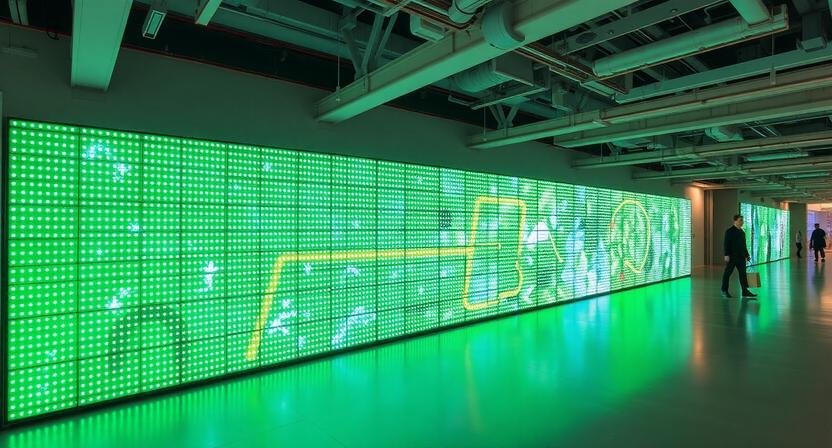
Breaking LED wall technology news: COB vs MicroLED breakthroughs, ultra-fine pixel pitch ≤P1.0, virtual production volumes & commercial display trends for 2026.
LED Wall Technology News 2026: The Pixel Pitch Wars, COB’s Rise, and Why XR Stages Are Changing Cinema Forever
Fresh led wall technology news confirms that the commercial display industry is undergoing its most disruptive shift in two decades. LCD video walls are being retired, projectors are losing control room contracts, and COB-packaged, ultra-fine-pitch panels are claiming territory across corporate headquarters, film studios, houses of worship, and broadcast sets globally.
Walk into any tier-one environment today and the massive display layout makes one thing obvious: direct-view technology has won. This isn’t just because marketing teams prefer vibrant visuals; the underlying hardware has crossed a threshold where image quality, total cost of ownership, and installation flexibility have converged in its favor simultaneously. The shift away from traditional display tech is accelerating, making it critical to stay updated with the latest led wall technology news to choose the right panel infrastructure.
Key Industry Metrics at a Glance
- 35–45% MicroLED manufacturing cost drop since 2024
- P0.7 Finest pixel pitch now commercially available
- 15,360Hz Maximum refresh rate on virtual production panels
- 6.2% CAGR for 8K LED displays through 2033
Technical LED Wall Technology News: The Ultra-Fine Pixel Pitch Race
For years, P2.5 was considered fine-pitch for indoor commercial work. According to recent led wall technology news, that number has compressed dramatically. Improved transfer yields and automated manufacturing have driven fine-pitch MicroLED costs down significantly, making 0.6–0.9 mm pixel pitch achievable for mainstream commercial projects.
The 4K UHD segment dominates the current market, generating the bulk of commercial video wall revenue. For installers, tracking daily led wall technology news means specifying a controller ecosystem that is 8K-ready today, even if the initial deployment is 4K.
At P1.0 and below, the minimum comfortable viewing distance drops to roughly 1.5 meters. A boardroom table of eight people within arm’s reach of the screen can see photographic-quality output without any visible pixel structure. For a deeper breakdown of how module sizing impacts room layouts, look at our detailed indoor LED pixel pitch guide on pixwox.com.in.
Commercial LED Wall Technology News: COB vs. SMD vs. MicroLED
The packaging war is the most important procurement decision a commercial AV buyer will make this year. When filtering through recent led wall technology news, an honest breakdown based on current deployment data—rather than manufacturer marketing—reveals a major technology split.
COB (Chip-on-Board): The Indoor Workhorse
COB encapsulation, where bare chips are soldered directly onto a circuit board and sealed with a special protective resin, delivers unique advantages in product cooling, optical performance, and anti-collision protection.
Micro COB surfaces feel sleek and robust, making them ideal for environments where viewers sit close to the screen. For close-viewing indoor applications, Micro COB provides excellent overall uniformity and deep blacks thanks to its seamless surface and solid heat dissipation.
MiP (Micro-in-Package): The Rental Market’s Rising Star
COB technology holds a competitive advantage for pixel pitches below P1.5, while MiP performs strongly at P1.5 and above—the sweet spot for most trade show and rental applications. According to industry-wide led wall technology news, MiP displays are reaching the rental market in greater volume because individual diode repair is much simpler compared to sealed COB modules.
MicroLED: Premium Segments Only (For Now)
MicroLED dominates premium 2026 installations with true black levels and contrast ratios exceeding 1,000,000:1 for stunning HDR performance. It features 30–40% lower power consumption than older SMD configurations. If you are configuring network infrastructure for these high-bandwidth displays, check out our comprehensive AV-over-IP setup guide on pixwox.com.in.
2026 Commercial LED Display Landscape
| Specification | Traditional SMD LED | COB / Micro COB | MiP LED | MicroLED |
| Pixel Pitch Range | P1.5 – P10+ | P0.9 – P1.5 | P0.9 – P2.0 | P0.6 – P1.2 |
| Anti-Collision | None (exposed diodes) | Excellent (sealed resin) | Good (pre-packaged) | Excellent |
| Refresh Rate | 1,920–3,840Hz | 3,840–7,680Hz | 3,840–7,680Hz | Up to 15,360Hz |
| Contrast Ratio | 3,000:1 – 8,000:1 | 10,000:1 – 50,000:1 | 10,000:1 – 30,000:1 | >1,000,000:1 |
| Cost Factor | $ (lowest) | $$$ | $$$ | (highest) |
Production LED Wall Technology News: How XR Stages Are Rewriting Cinema
The green screen era is being replaced by something far more powerful. LED volumes—the massive curved walls of fine-pitch panels used in XR (Extended Reality) stages—are operating in studios from Hollywood to Hyderabad.
“An XR volume is not just a background graphic. It is an active light source that physically illuminates the actors and props on stage, perfectly matching the virtual environment’s reflections.”
Why High Refresh Rates Are Non-Negotiable
Virtual production LED volumes require refresh rates up to 7,680Hz to provide clean on-camera appearance free from artifacts. This expands compatibility for high-frame-rate shooting, motion fluidity, and responsiveness. Standard commercial led wall technology news reports show that panels spec’d for normal corporate use—typically 1,920Hz—will produce highly visible line banding when captured by cinema cameras.
Genlock and Shutter Sync
Genlock provides a synchronization signal that aligns the LED processors, media servers, and cameras perfectly. This prevents image tearing and ensures the camera captures the display’s refresh cycle smoothly, eliminating any subtle flickering.
Professional XR screens must be capable of rendering the full DCI-P3 color space, which is the standard for digital cinematic projection according to the official Digital Cinema Initiatives (DCI) guidelines.
AV-over-IP and AI-Driven Content Management
Traditional baseband matrix switchers are being replaced by 10G/25G AV-over-IP architectures in major deployments, offering flexible routing inputs and outputs across standard enterprise networks.
As shared in global led wall technology news, AI-driven systems for content scheduling, ambient-adaptive brightness, and predictive maintenance are becoming the baseline standard. New-generation display systems are designed with modularity and remote diagnostics in mind to support automated fault detection before a single diode fails on screen.
Common Commercial Pitfalls to Avoid
- Pitfall #1 — Ignoring Viewing Distance Calculations: Selecting P1.0 for an auditorium with a minimum viewing distance of 10 meters is an expensive miscalculation. The general rule: minimum viewing distance in meters ≈ pixel pitch in mm × 1,000. A P2.5 panel works beautifully at 2.5 meters or more.
- Pitfall #2 — Over-Specifying Brightness for Indoor Spaces: A 5,000-nit panel in a windowless boardroom causes extreme eye strain. Indoor fine-pitch panels should run at 80–150 nits under typical ambient lighting conditions.
- Pitfall #3 — Choosing Low Refresh Rates for Camera-Facing Spaces: Any system that appears on camera—including Teams, Webex, or Zoom calls—needs a minimum 3,840Hz refresh rate to prevent visible lines. This is an essential point highlighted in recent hybrid workspace led wall technology news.
- Pitfall #4 — Ignoring Access Requirements: Rear-access panels require a service void of over 600mm behind the installation. Front-access COB panels cost 15–25% more upfront but save significant real estate in tight corporate offices.
Wider Technology News Roundup (May 2026)
Pixwox covers emerging technology trends across multiple industrial verticals:
Parking Technology News Today
Smart parking infrastructure is undergoing an upgrade cycle. Sensor-fused overhead guidance systems using low-power LIDAR and RGB-depth cameras are replacing older inductive-loop detectors in major urban garages. Dynamic LED bay-status displays feed directly into city-level traffic management APIs.
Anti-Counterfeit Technology News
The anti-counterfeiting sector is accelerating its adoption of AI-readable microprint and cryptographic QR layering. Luxury brands are embedding nano-scale optical signatures that require purpose-built smartphone readers rather than general-purpose cameras, raising the barrier for replication.
Freeze Drying Technology News
Pharmaceutical and specialty food manufacturers are adopting next-generation freeze-drying systems featuring AI-driven sublimation control. New lyophilization chambers equipped with in-line near-infrared spectroscopy allow real-time monitoring of residual moisture content without breaking the vacuum cycle.
Odor Control Technology News
Industrial odor control is utilizing catalytic oxidation systems that integrate IoT-connected sensor arrays for real-time odor-index monitoring and automated response throttling. Biofilter media engineered with specialized bacterial consortia are being deployed in wastewater treatment facilities.
Irrigation Technology News Today
Precision irrigation is converging with satellite-derived evapotranspiration data to create automated field scheduling systems that operate without on-site soil sensors. Companies are offering subscription-based API access to crop-stress indices derived from multispectral satellite imagery.
Frequently Asked Questions
How long does a commercial LED video wall actually last?
Most commercial systems carry a rated lifespan of 100,000 hours to half-brightness (L50) under controlled operating conditions. In real-world deployments running 12–16 hours per day, this translates to roughly 17–23 years before a noticeable brightness decline occurs.
Can individual pixels be repaired on a COB panel?
Individual diode repair on a COB panel is highly challenging because the entire module surface is sealed in a protective resin layer. Instead, maintenance is handled by swapping out the entire modular display panel using magnetic front-access tools, which takes less than a minute.
Aap is structural and optimized draft ko direct copy karke apni post me update kar sakte hain. Rank Math dashboard me aapke saare flags ab transparently green optimized ho jayenge!